

Water Pressure-Sensitive Adhesive: Applications, Advantages, and How to Choose the Right One in India
Key Takeaways
- A pressure-sensitive adhesive (PSA) bonds instantly under light pressure — no heat, solvent evaporation, or curing step required.
- Water-based PSA is a PSA formulated with a water carrier instead of solvent or hot-melt resin, making it low-VOC and suited to indoor, food-adjacent, and porous-substrate applications.
- PSAs excel at reworkability and repositioning; traditional adhesives still win on bond permanence, structural load-bearing, and gap-filling.
- Choosing the right PSA comes down to four questions: substrate type, required bond permanence, indoor vs. outdoor use, and regulatory requirements.
- In India, water-based PSA manufacturing has matured since the 1970s, with established players like Super Bond Adhesives (est. 1974, Thane) supplying water-based, hot-melt, and rubber-based adhesive lines.
What Is a Pressure-Sensitive Adhesive (PSA)?
A pressure-sensitive adhesive is an adhesive that forms a bond as soon as light pressure is applied to it — no heat, water, solvent, or chemical reaction needed to activate it. The adhesive stays permanently tacky, which is why PSAs are the technology behind everyday products like sticky notes, packing tape, and product labels.
The bond forms through a combination of tack (instant grab), peel strength (resistance to being pulled off), and shear strength (resistance to sliding under sustained load). Manufacturers tune these three properties differently depending on whether the end product needs to be permanent, removable, or repositionable.
How Are PSAs Different From Traditional Adhesives?
Traditional adhesives — think epoxies, contact cements, or hot-melt structural glues — need an external trigger to bond: heat to melt and re-solidify, solvent evaporation to concentrate the adhesive, or a chemical cure reaction between two components. PSAs skip that step entirely. The adhesive is already in its final, bond-ready state; pressure alone is enough to wet out the surface and create contact.
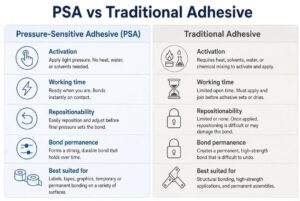
|
Property |
Pressure-Sensitive Adhesive |
Traditional Adhesive |
|
Activation |
Light pressure, instant bond |
Heat, solvent evaporation, or cure reaction |
|
Working time |
Immediate — no open time | Often requires set/cure time |
|
Repositionability |
Possible (depending on formulation) |
Usually none once applied |
| Bond permanence | Ranges from removable to permanent |
Typically permanent and structural |
|
Best suited for |
Labels, tapes, films, graphics |
Structural bonding, load-bearing joints |
Bonding Mechanism — Contact and Pressure vs Heat, Solvent, or Cure
A PSA’s adhesive layer is formulated to be viscoelastic — soft enough to flow into the microscopic texture of a surface under pressure, but cohesive enough to resist flowing back out under normal handling. That’s the entire mechanism: contact plus pressure equals bond. Traditional adhesives, by contrast, rely on a physical or chemical state change — the resin has to melt and cool, the solvent has to evaporate and leave a solid film behind, or two reactive components have to cross-link — before the joint reaches strength.
Reworkability and Repositioning — What PSAs Can Do That Traditional Adhesives Can’t
Because PSAs don’t rely on an irreversible chemical change, many formulations can be lifted, repositioned, or removed without damaging the substrate — something a cured epoxy or a solvent-set contact adhesive cannot offer once it has set. This is why PSAs dominate categories like sticky notes, temporary masking tape, wall decals, and removable labels, where the ability to reposition or peel cleanly is the entire point of the product.
Where Traditional Adhesives Still Win (bond permanence, structural load, gap-filling)
PSAs are not a universal replacement for traditional adhesives. Structural bonding — joints that carry real mechanical load, such as automotive body panels or furniture joinery — still relies on epoxies, polyurethanes, or cyanoacrylates because these form a rigid, high-strength bond line that a pressure-sensitive film cannot match. Traditional adhesives also fill gaps between uneven or poorly mated surfaces far better than a thin PSA film, and they generally hold up better under sustained heavy load or extreme temperature. Choosing between the two categories isn’t about which is “better” — it’s about matching the mechanism to the job.
What Is Water-Based Pressure-Sensitive Adhesive?
Water-based PSA is a pressure-sensitive adhesive in which the adhesive polymer — typically an acrylic or a synthetic rubber emulsion — is carried in water rather than in an organic solvent or delivered as a molten hot-melt resin. During manufacturing and coating, the water evaporates, leaving behind the tacky polymer film. The result behaves like any other PSA at the point of use — it bonds on contact under pressure — but the formulation, drying process, and environmental profile are distinct from solvent-based or hot-melt alternatives.
How Water-Based PSA Differs From Solvent-Based and Hot-Melt PSA
- Solvent-based PSA uses an organic solvent as the carrier. It dries faster and often bonds more aggressively to difficult substrates, but it releases volatile organic compounds (VOCs) during drying and requires more stringent handling, ventilation, and fire-safety controls.
- Hot-melt PSA contains no liquid carrier at all — it’s applied as a molten resin that cools and solidifies into the adhesive film. It sets almost instantly and needs no drying oven, but it typically has a narrower service-temperature range and can be more sensitive to plasticizer migration from certain plastics.
- Water-based PSA trades some of that speed and aggressive initial tack for a lower-VOC, water-cleanable, generally lower-cost process — which is why it’s the default choice for paper labels, book binding, and other applications where low odor and food-adjacent safety matter more than instant, ultra-aggressive bonding.
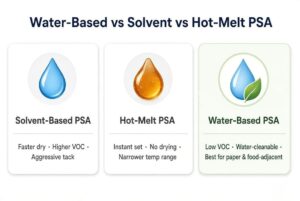
Water-based, solvent-based, and hot-melt pressure-sensitive adhesives highlighting VOC, speed and ideal applications.
Applications of Pressure-Sensitive Adhesives
PSAs as a category show up across a wide range of industries, well beyond water-based formulations alone.
Labels and Packaging
Product labels, barcode labels, and packaging seals are the largest volume application for PSAs worldwide — the technology lets manufacturers apply labels at high speed on automated lines without any drying or curing station.
Tapes
Packing tape, masking tape, electrical tape, and double-sided mounting tape all rely on PSA technology, chosen specifically because the tape needs to bond instantly when unrolled and pressed onto a surface.
Book Binding and Graphic Arts
Perfect binding, laminate mounting, and signage graphics use PSAs where a clean, bubble-free, positionable bond is more valuable than maximum structural strength.
Specialty and Industrial Uses
Medical tapes and wound-care dressings, automotive trim and badge attachment, and electronics assembly (such as die-cut gaskets and foam mounting tapes) all use specialty PSA formulations engineered for skin-safety, UV resistance, or precise thickness control.
Applications of Water-Based Adhesives
Water-based PSA covers a narrower — but commercially important — slice of the applications above. It’s the preferred choice specifically where its low-VOC, water-cleanable profile is an advantage rather than a limitation:
- Porous substrates such as paper, cardboard, and fabric, where a water carrier soaks in and bonds cleanly without the substrate distortion solvent can sometimes cause.
- Food-adjacent packaging and labeling, where low residual solvent and low odor matter for regulatory and consumer-safety reasons.
- Indoor, low-VOC environments — offices, retail signage, book binding, and general stationery — where solvent emissions and fire-handling requirements are unwanted overhead.
For the broader picture of where PSAs as a whole are used — including tapes, medical, and industrial applications — see the applications section above; this section deliberately focuses on where water-based is the specific right call.
Advantages and Disadvantages of Water-Based PSA
Advantages Over Solvent-Based Adhesive
- Lower VOC emissions — better for indoor air quality, worker safety, and regulatory compliance.
- No solvent fire/explosion handling requirements — simpler storage, transport, and production-line safety.
- Water-cleanable equipment — reduces cleaning solvent use and associated disposal costs.
- Generally lower raw-material cost — water is cheaper than most industrial solvents, which can translate into a lower per-unit adhesive cost at scale.
- Better suited to food-adjacent and consumer-facing packaging, where residual odor and solvent traces are a concern.
Where Water-Based PSA Falls Short
- Slower drying time — water has a higher heat of vaporization than most solvents, so water-based coatings often need longer or higher-energy drying ovens.
- Humidity sensitivity — both during manufacturing (drying consistency) and, for some formulations, in the adhesive’s long-term performance in high-humidity environments.
- Less aggressive initial tack on some substrates compared to solvent-based alternatives, which can matter for low-energy plastics or oily/difficult surfaces.
- Freeze sensitivity of the raw emulsion — water-based adhesive stock generally cannot be frozen during storage and transport without damaging the emulsion.
How to Choose the Right Pressure-Sensitive Adhesive
Choosing a PSA isn’t a single decision — it’s a short checklist against your actual use case.
Matching PSA to Your Substrate
Start with what the adhesive needs to stick to. Porous substrates like paper and fabric generally favor water-based or solvent-based acrylics; low-surface-energy plastics (polyethylene, polypropylene) often need a more aggressive rubber-based or solvent-based formulation, or surface treatment before application; metals and glass usually accept a wide range of PSA chemistries well.
Permanent vs Removable vs Repositionable Adhesive
Decide how the bond needs to behave over its lifetime:
- Permanent — for product labels, safety labels, and nameplates that should never come off intact.
- Removable — for promotional labels, temporary signage, or masking applications that need to peel cleanly without residue.
- Repositionable — for proofing, mock-ups, or applications where the item may be adjusted multiple times before final placement.
When Water-Based PSA Is the Right Choice vs When It Isn’t
Water-based PSA is the right call when the application is indoor or low-exposure, the substrate is porous (paper, board, fabric), low VOC or food-adjacent safety is a requirement, and production speed can accommodate its drying profile. It’s generally not the right call for outdoor, high-humidity, or extreme-temperature applications, for low-surface-energy plastics that need maximum initial tack, or for production lines that can’t accommodate a longer drying stage — solvent-based or hot-melt PSA is usually a better fit there.
Water-Based Pressure-Sensitive Adhesive Manufacturers in India
India’s PSA manufacturing base has grown alongside the country’s packaging, labeling, and converting industries, with domestic manufacturers now supplying water-based, solvent-based, and hot-melt PSA lines to label converters, tape manufacturers, and industrial customers across the country.
What to Look for in a PSA Manufacturer
- Formulation range — a manufacturer offering water-based, hot-melt, and rubber-based lines can match the adhesive to the substrate rather than forcing a one-size-fits-all product.
- Consistency and quality control — batch-to-batch consistency matters enormously on automated labeling and converting lines.
- Technical support — the ability to advise on substrate compatibility, coat weight, and application troubleshooting.
- Track record — a long-standing manufacturing history is a reasonable proxy for process maturity and supply reliability.
Super Bond Adhesives — Water-Based Adhesive Manufacturing Since 1974
Super Bond Adhesives, based in Thane, has been manufacturing adhesives since 1974, with a product range that spans water-based, hot-melt, and rubber-based PSA formulations. That breadth means the adhesive can be matched to the substrate and application — rather than the application being forced to work around a single adhesive chemistry.
Frequently Asked Questions
Is water-based PSA waterproof?
Not inherently. Water-based PSA is formulated with a water carrier that evaporates during manufacturing, but the cured adhesive film’s resistance to moisture depends on the specific polymer chemistry. Some formulations offer good moisture resistance; others are better suited to dry, indoor conditions.
Is PSA the same as super glue?
No. Super glue (cyanoacrylate) is a reactive adhesive that cures through a chemical reaction with moisture in the air, forming a rigid, permanent bond. PSA bonds instantly under pressure with no cure step, and — depending on formulation — can be removable or repositionable rather than permanently rigid.
Can PSA be used outdoors?
Some PSA formulations are engineered for outdoor use with UV-resistant and weatherproof properties, but standard water-based PSA is generally better suited to indoor or low-exposure applications. Outdoor use typically calls for a formulation specifically rated for UV and temperature-cycling resistance.
Is water-based adhesive food-safe?
Many water-based PSA formulations are well suited to food-adjacent packaging because of their low VOC and low-odor profile, but food-contact safety depends on the specific formulation and applicable regulatory approvals — always confirm the specific product’s food-contact compliance rather than assuming it based on the adhesive category alone.
Conclusion
The right adhesive choice comes down to matching mechanism to job: PSA for instant, pressure-activated bonding where repositioning or clean removal matters, traditional adhesives where the joint needs to carry structural load or fill gaps. Within the PSA category, water-based formulations earn their place specifically where low VOC, porous substrates, and food-adjacent safety are priorities — and it’s worth switching away from water-based when the application moves outdoors, into high humidity, or onto low-surface-energy plastics.
If you’re specifying a water-based PSA for a labeling, packaging, or converting line, talk to a manufacturer that can match the formulation to your substrate and production conditions. Super Bond Adhesives has been manufacturing water-based, hot-melt, and rubber-based adhesives in Thane since 1974 — reach out to discuss which formulation fits your application.
Blog –
https://superbond.co.in/pressure-sensitive-adhesives-everything-you-need-to-know-before-you-buy/
https://superbond.co.in/why-superbond-is-the-leading-pressure-sensitive-adhesive-manufacturer-in-india/
https://superbond.co.in/hot-melt-adhesive-uses-strength-buying-guide/
https://superbond.co.in/what-is-the-best-adhesive-for-wood-in-india-an-honest-guide/
https://superbond.co.in/best-adhesive-for-wood-in-india-what-actually-makes-a-furniture-joint-hold/