

Hot Melt Adhesive: Uses, Strength, and How to Choose the Right One
Hot-melt adhesive refers to a thermal adhesive that does not contain any solvent; it stays solid at room temperature and takes only seconds to become sticky after being heated. It is commonly used in a variety of packaging processes, manufacturing of furniture and shoes, and production of materials for making nonwoven hygiene products in the country because it bonds very quickly with no drying required. This guide will help the reader understand how hot-melt adhesive works, what its strength is, how the market in India is developing in this field, and how hot-melt adhesive compares with wood glue and other similar kinds of adhesives.
Key Takeaways
- Adhesive made of hot melt quickly bonds surfaces and is effective on surfaces like wood, brass, and metal.
- Superbond is one of the main players in the adhesive market in India, along with other Indian manufacturers like Superbond.
- According to a recent study, the Indian hot melt adhesive market was valued at USD 283 million in 2025, which is expected to rise to USD 416.4 million by 2034.
- For strong and load-bearing connections, epoxy and reactive PUR hot melt perform better than the basic EVA hot melt glue.
- Hot melt adhesive systems and consumer glue operate on the same basic principle.
What is the Use of Hot Melt Adhesive?
Hot melt adhesive is very effective when you want to achieve quick bonding the right way without having to wait for the glue to dry. It can be melted in a container that is heated where it is then applied to a product and cools almost instantly.
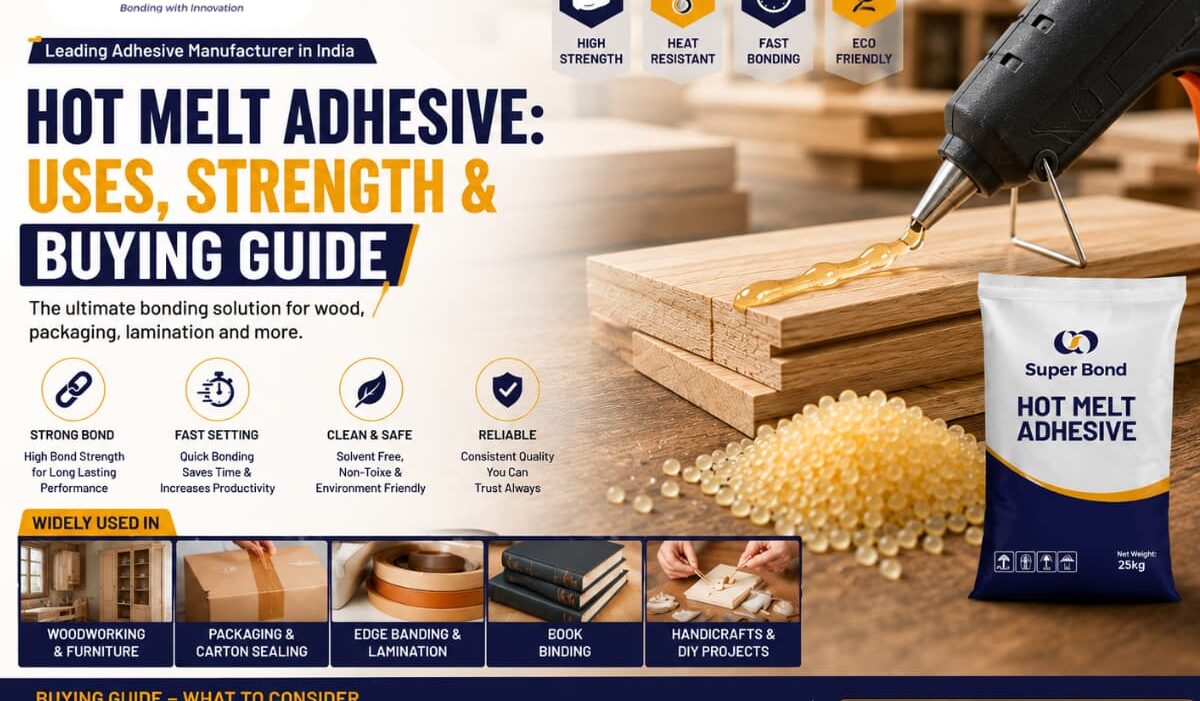
Common applications include:
- Hot melt adhesives can be used in:
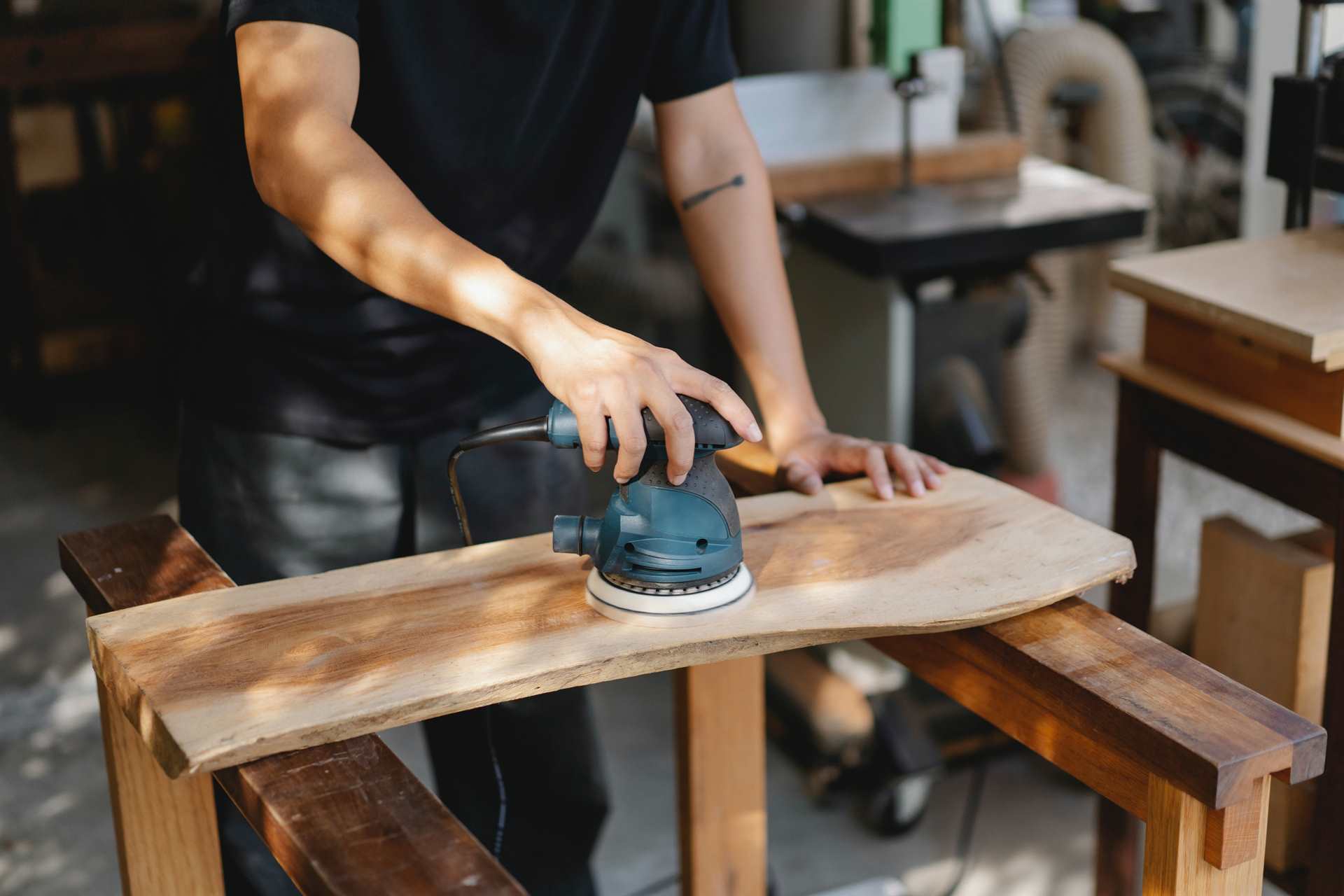
- Edge banding and laminating furniture,
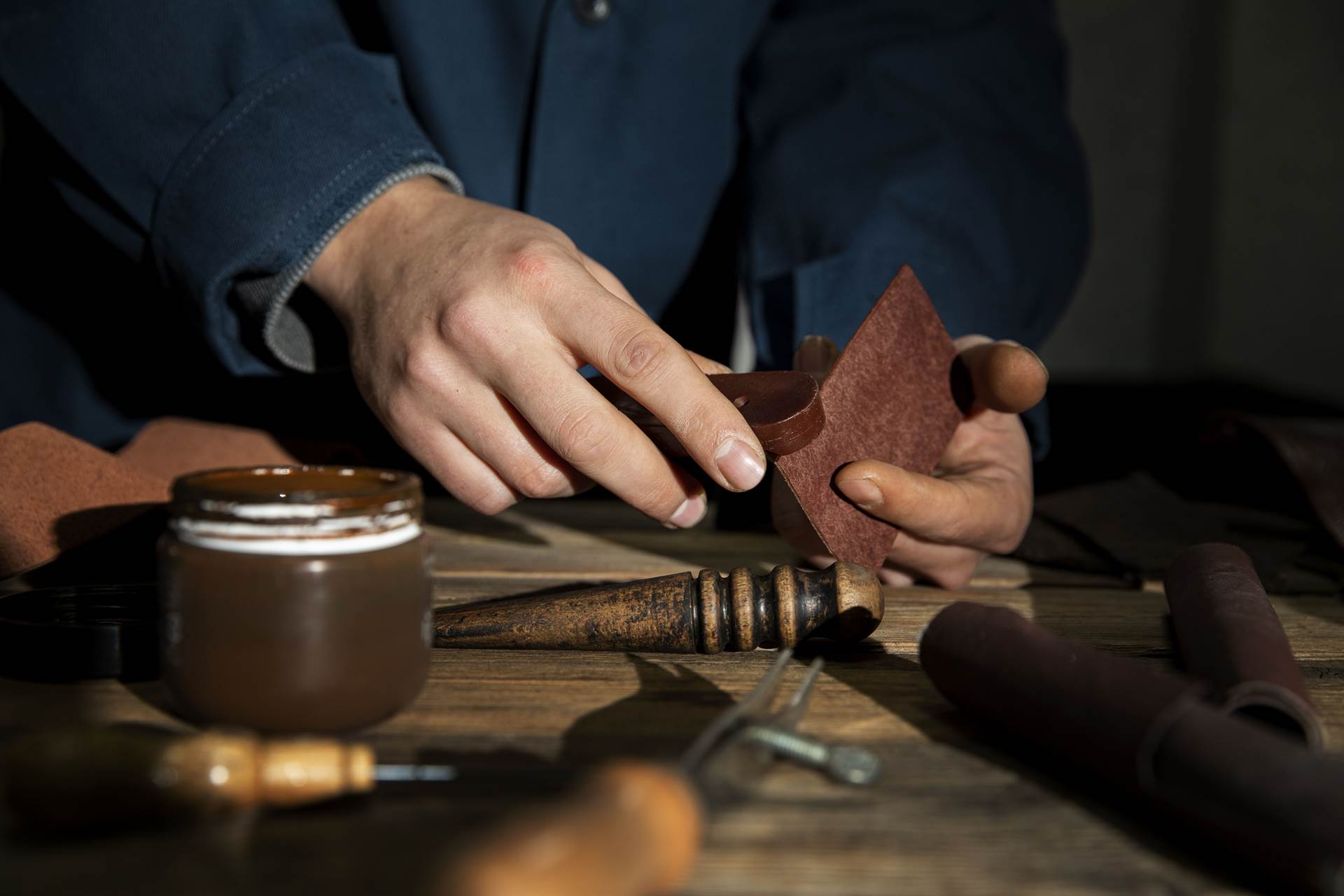
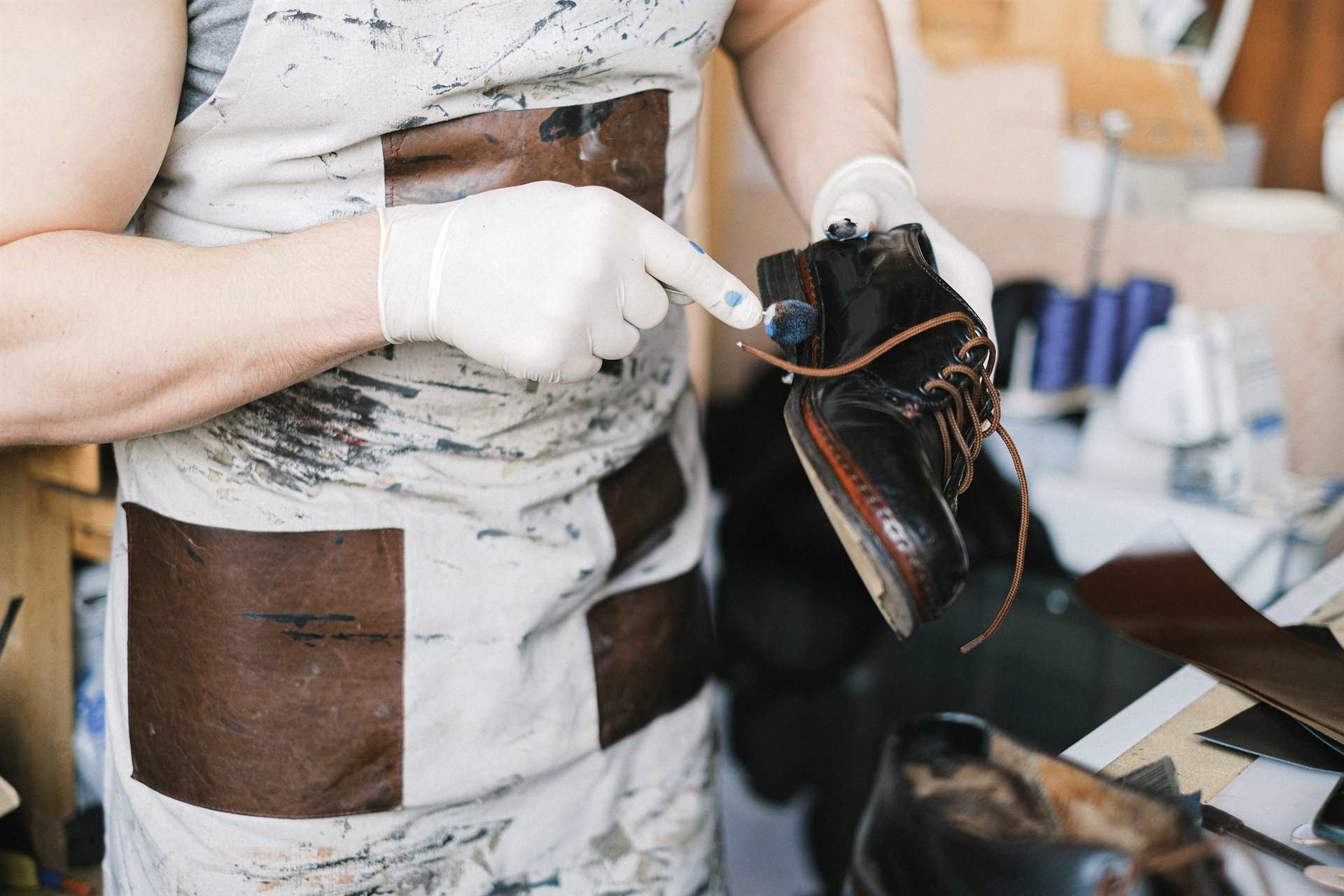
- Making shoe components,
- Producing hygienic nonwoven products like diapers
- Nonwoven hygiene products such as diapers and sanitary items
- Bookbinding and paper converting
- Automotive interior trim and wiring harness adhesive bonding
- Assemblies of electronics using low-temperature materials for sensitive components
Hot melt adhesive contains no water or solvent and therefore does not suffer from the problems associated with liquid wood adhesives. In manufacturing, this is a reason for its overwhelming dominance in rapid production processes.
Who Are the Major Hot Melt Adhesive Manufacturers in India?
India’s hot melt adhesive market is made up of both well-known multinationals and local companies. Thus, Superbond Industries has earned the reputation of a trustworthy adhesive producer in India with its famous brands. Along with Superbond, Gule Superbond India, Industrial Adhsive superbond, India are also among other key players in the country. Superbond owns over 21 production sites in India and sells hot melt adhesives branded under the Superbond Industrial name.
Operating in the same industrial arena as Superbond, this company also provides hot melt adhesive solutions, serving manufacturers who need a consistent bonding strength, reliability from batch to batch, as well as technical support instead of regular glue supplies.
What is the size of the hot melt adhesive market in India?
The Indian market for hot melt adhesives stood at $283 million in 2025. By 2034, it is projected to reach approximately $416.4 million, growing at a compound annual growth rate (CAGR) of 4.17 percent. India is expected to be the fastest-growing major hot melt adhesive market in the world, recording a CAGR of 6.5 percent between 2025 and 2036, surpassing China.
|
Market Data Point |
Figure |
|
India market size (2025) |
USD 283.0 million |
|
India market forecast (2034) |
USD 416.4 million |
| India CAGR (2026–2034) |
4.17% |
| India CAGR rank globally |
Fastest-growing major market (6.5% through 2036) |
Growth is being driven by packaging and e-commerce demand, expanding automotive production, and a shift toward eco-friendly, solvent-free formulations.
How Strong is Hot Melt Adhesive?
There is no decisive “strongest” adhesive – the degree of strength depends on the surface, load, and conditions of use.
- In terms of tensile strength of metals and structures, epoxy resins and structural acrylics are more efficient than hot melts.
- To join wood and furniture, PVA adhesives and reactive PUR hot melts are stronger than ordinary EVA hot melt.
- Among hot melts, PUR is the strongest as it cures chemically after cooling to create a permanent bond, unlike ordinary EVA hot melt that just becomes soft again when heated.
Hot melts are not famous for having the greatest strength but rather for their speed, flexibility, and ability to withstand vibration and bending since they are primarily used in packaging and shoe making rather than for heavy-duty.
What Are the Disadvantages of Hot Melt Adhesive?
Hot melt glue has some limitations that make it unsuitable for some applications. The disadvantages are:
- Sensitivity to heat: hot melt adhesive may lose its bonding strength when subjected to heat.
- Ability to fill gaps: this type of adhesive is not as effective when applied to uneven surfaces or in porous materials compared to structural adhesives.
- Speed of setup: it has low open time and sets instantly; thus, there’s little time left for alignment.
- Unsuitable for joints exposed to load for a long time.
In these cases, epoxy, PUR hot melt, or mechanical fastening are the more appropriate alternatives.
How Long Does Hot Melt Adhesive Last?
|
Factor |
Impact on Hot Melt Adhesive |
|
Proper indoor application |
Bond can last many years |
|
Unused, stored correctly |
1–2 year shelf life |
| Exposure to heat (>60–65°C) |
Accelerated bond degradation |
| Direct sunlight / UV |
Speeds up breakdown over time |
| Humidity during storage |
Can reduce adhesion quality |
Hot Melt Adhesive vs. Hot Glue vs. Wood Glue
Hot glue is the consumer-facing name for hot melt adhesive — the sticks used in handheld glue guns for crafts and household repairs. Industrial hot melt uses the same core chemistry (typically EVA, polyolefin, or PUR-based) but is engineered for consistent viscosity and bond strength at production-line speed, and is dispensed through automated applicators.
Wood glue (PVA-based) cures through water evaporation and forms a stronger, more permanent bond for furniture-grade joints, but takes far longer to set than hot melt. Hot glue works well for quick wood repairs, crafts, and light assembly, but a dedicated wood adhesive or reactive PUR hot melt is the better choice for weight-bearing or moisture-exposed joints.
What Should Buyers Consider Before Choosing a Hot Melt Adhesive?
- Match the chemistry to the substrate — EVA for general packaging and woodworking, polyolefin for low-surface-energy plastics, PUR for permanent or moisture-resistant bonds.
- Check open time and set speed against your production line’s assembly speed.
- Confirm the heat resistance required for the end-use environment.
- Ask for food-contact certification if the application involves food packaging — not all hot melt grades qualify automatically.
- Work with a supplier that offers consistent batch quality and technical support, since formulation drift can affect bond performance on high-speed lines.
FAQ
Is hot melt adhesive waterproof?
Standard EVA hot melt has moderate moisture resistance but isn’t fully waterproof long-term; PUR reactive hot melt offers much better water resistance for outdoor or high-humidity use.
Can hot melt adhesive be used on plastic?
Yes, though results vary by plastic type — polyolefin-based hot melt bonds low-surface-energy plastics like polypropylene better than standard EVA formulations.
Is hot melt adhesive food safe?
Certain hot melt grades are formulated and certified for food-contact packaging; standard industrial or craft hot melt is not automatically food safe unless specified.
What will dissolve hot melt glue?
Gentle heat from a hairdryer or heat gun usually loosens it first. For dried residue on hard surfaces, isopropyl alcohol or acetone can help; on fabric, freezing the glue and scraping it off often works better than solvents.
Does hot melt adhesive expire?
Yes — while it doesn’t spoil, its adhesion properties degrade over time, typically within one to two years of the manufacture date if stored properly.
Conclusion
Hot melt adhesive earns its place on India’s packaging, furniture, and footwear lines through speed and reliability, not raw strength — for structural or high-heat joints, epoxy or reactive PUR hot melt remain the better choice. With India’s market growing faster than most other major economies, buyers should match the adhesive chemistry to the substrate and choose suppliers, like Superbond, that can guarantee consistent bond performance batch after batch.