
Best Adhesive for Wood in India
Ask a carpenter what the strongest glue for wood furniture is, and you’ll get a brand name. Ask a chemist, and you’ll get an uncomfortable answer: the question is wrong.
A properly made wood glue joint is stronger than the timber around it. Break it, and the wood fibre tears — the glue line holds. So “which glue is strongest” stops being a useful question almost immediately.
The question that actually decides whether your furniture survives is this one: how much water is this joint going to see, and for how long?
That’s what this guide is about.
The Points, in Short
- A good wood bond is stronger than the wood itself. The joint fails in the fibre, not the glue.
- What separates a good wood adhesive from a bad one is durability class, not raw strength.
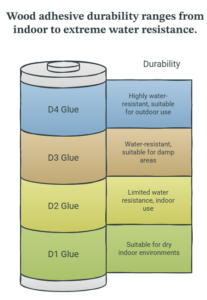
- The EN 204 system grades wood glues D1 to D4 by water resistance. D1 and D2 are indoor only. D3 is water-resistant. D4 is the highest.
- In India, humidity is the enemy. A D1 glue in a coastal kitchen is a failed joint waiting to happen.
- Indian standards exist and matter: IS 4835 for PVA wood adhesives, IS 851 for non-structural synthetic resin adhesives in wood, and IS 848 for plywood adhesives.
- India’s wood adhesive market was USD 249.59 million in 2024, heading for USD 510.49 million by 2033.
Why “Strongest Glue for Wood” Is the Wrong Question
Your Glue Is Already Stronger Than Your Timber
PVA — the white or yellow glue most Indian furniture is built with — forms a bond whose strength is considerably higher than that of the wood itself. Clamp a joint properly, let it cure, then try to break it. The wood gives way first.
So if two glues both exceed the strength of the timber, “stronger” is a marketing word rather than an engineering one. Both joints fail in the same place, at the same load.
What Actually Kills a Furniture Joint
Moisture. Almost always moisture.
PVA is not naturally resistant to it. Put an ordinary PVA joint in a damp environment, and its strength drops substantially. The bond didn’t fail because the glue was weak. It failed because the glue was unmodified, and nobody asked what conditions the joint would have to live in.
This is why a wardrobe in Jaipur behaves differently from the same wardrobe in Kochi. Same design, same timber, same glue, two completely different outcomes.
So What Should You Ask Instead?
Three questions, in this order.
Where does this joint live?
Dry interior, humid interior, wet interior, or outdoors.
What durability class does that demand?
D1 through D4 are explained next.
What’s my working time and clamp time?
Because the strongest glue in the world is useless if it skins over before you’ve closed the joint.
Understanding EN 204: The D1 to D4 Durability Classes
This is the single most useful thing in this article, and most people buying wood glue in India have never heard of it.
What the D Number Means
EN 204 is the European standard that classifies thermoplastic wood adhesives for non-structural use. It sorts them into four durability classes by water resistance, D1 at the bottom and D4 at the top. The D stands for durability. It says nothing about strength.
|
Class |
Where it belongs |
The condition it’s rated for |
|
D1 |
Interior, dry |
Temperature rarely above 50°C. Wood moisture content up to 15%. |
|
D2 |
Interior |
Occasional short exposure to water or condensation, occasional high humidity. Wood moisture up to 18%. |
|
D3 |
Interior, humid |
Frequent short exposure to running or condensed water, frequent high humidity. Also, outdoor furniture is not exposed to the weather. |
|
D4 |
Interior, wet |
Frequent, prolonged exposure to running or condensed water. Kitchens, bathrooms, high-humidity environments. |
How the Classes Are Tested
They aren’t marketing labels. They’re measured.
A D3 adhesive tested to EN 204:2016 has to hold a bond strength above 2 N/mm² after seven days at ambient conditions, followed by four days with the specimen submerged in cold water.
The companion test method, EN 205, spells out how. Beech specimens. Adhesive spread at 150 g/m². Pressed at 0.7 N/mm² for two hours. Twenty results reported — and alongside each one, the wood-failure percentage.
Read that last part again, because it settles the argument this article started with. The official test standard records how much of the break happened in the wood rather than in the glue. The people who wrote the standard already knew where a good joint fails.
One more thing worth knowing: EN 204 deliberately does not specify the temperature resistance of the bond line. That’s a separate test, DIN EN 14257, which the trade calls WATT 91. So a D4 rating tells you about water, not heat. If your joint will get hot as well as wet, you need both numbers.
And a word on language. D4 is loosely called “waterproof” in the trade. Strictly, that isn’t what the standard says — D4 is the highest durability class, which is not the same thing as immunity to water. Anyone selling you “waterproof” glue is using a word that the standard doesn’t.
A supplier claiming D3 without a test report behind it is claiming nothing at all.
Which Class Does Indian Furniture Actually Need?
Here’s where honest advice diverges from what’s easy to sell.
For a bedroom wardrobe in a dry climate, D2 is genuinely adequate. But India isn’t one climate. A kitchen cabinet anywhere on the coast, a bathroom vanity, a dining table wiped down twice a day, anything shipped through a monsoon and stored in a godown — that’s D3 territory at minimum.
If the joint will see standing water or long-term condensation, go to D4 and stop arguing about it. The glue is the cheapest component in the furniture. The rework is not.
One useful technical note. Some D3 adhesives can be lifted to D4 performance by adding a crosslinker, typically at around 5% of the formulation. If you’re sitting near the boundary, ask whether that’s an option for the grade you already run.
Which Type of Wood Adhesive Should You Use?
Different jobs, different chemistries. Anyone selling you one glue for everything is selling you what they have in stock.
The Main Families
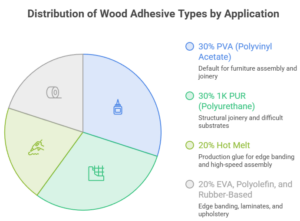
PVA (polyvinyl acetate). The default for furniture assembly and joinery. Easy to apply, cleans up with water, has a low odour, and forms a bond stronger than the wood. Its weakness is water, which is exactly what the D-class system exists to manage. Modified and crosslinked PVAs reach D3 and D4.
1K PUR (polyurethane). Single-component, moisture-curing. Bonds to itself and to dissimilar materials, tolerates heat and vibration, and holds up where plain PVA won’t. This is where you go for structural joinery, panel lamination, and anything with a difficult substrate on one side.
Hot melt. No solvent, no drying stage, sets on cooling. This is production glue — edge banding, profile wrapping, high-speed assembly. Its strength is speed and instant handling, not gap-filling.
EVA, polyolefin, and rubber-based. Workhorses across edge banding, laminates, and upholstery, chosen for tack, open time, and heat resistance rather than headline bond figures.
Working Time and Cure: Two Numbers Buyers Forget
Open time is how long you have between spreading the glue and closing the joint. Too short and you’re fighting the adhesive. Too long, and the line stalls waiting for it.
Full cure is not the same as handling strength. Depending on formulation and conditions, a wood adhesive typically reaches full bond strength somewhere in the 24 to 72 hour window. If your line is moving product before that, you are relying on handling strength — and you need to know exactly what it is.
A Word on Gap Filling
Wood is not flat. Timber cups, boards twist, tenons don’t seat perfectly.
An adhesive with poor gap-filling ability turns a 0.3mm gap into a weak point. If your joinery is machine-cut and tight, most adhesives will cope. If you’re bonding hand-cut joints, or engineered board with a variable edge, ask specifically about gap-filling performance before you commit.
What Do Indian Standards Say About Wood Adhesives?
Most wood glue blogs in India skip this entirely. It matters, particularly if you supply institutional buyers, government tenders, or export markets.
The Standards That Apply
IS 4835 — Specification for polyvinyl acetate dispersion-based adhesives for wood. This governs the PVA sitting in most Indian carpentry workshops.
IS 851 — Specification for synthetic resin adhesives for construction work (non-structural) in wood.
IS 848 — Specification for synthetic resin adhesives for plywood, phenolic, and aminoplastic.
If a supplier can’t tell you which Indian Standard their product conforms to, that itself is a data point about the supplier.
Why This Matters More Each Year
BIS Quality Control Orders now set minimum performance for wood-based board inputs such as plywood, MDF, and particle board. As certification tightens across the panel supply chain, adhesive documentation gets pulled along with it. Green building criteria and chain-of-custody certification push in the same direction, towards lower-emission adhesives and verifiable inputs.
Put plainly: the paperwork on your glue is going to matter more each year, not less.
What to Ask Your Supplier For
- Technical data sheet, with open time, clamp time, and full cure time
- The EN 204 durability class, with a test report behind it
- The Indian Standard that the product conforms to
- Safety data sheet and VOC information
- Gap-filling and heat-resistance data, if your application needs it

How to Choose the Best Wood Adhesive for Your Work
Match the Class to the Climate, Not the Catalogue
Work backwards from where the furniture will live. Coastal humidity, a kitchen, a bathroom, an open verandah — each one raises the durability class you need. Then buy that class. Don’t buy the grade that happened to be on offer and hope.
Test on Your Actual Timber, and Break the Joint
Teak, sheesham, rubberwood, MDF, plywood, particle board, and HDF do not behave the same way. Oily hardwoods, in particular, can resist a bond that works perfectly on a softwood. Trial the glue on the species and the board you actually use, in the humidity you actually work in.
Then make a joint and break it. Look at the failure surface. If the wood tore, your glue is doing its job. If the glue line is clean and shiny, it isn’t.
That test takes ten minutes, and almost nobody does it.
Buy on Cost-in-Use, Not Price Per Kilo
Spread rate times price. That’s the number. A cheaper glue applied heavily, with a longer clamp time that slows your line, can easily cost more per finished piece than the grade you rejected on price.
Conclusion: The Best Wood Adhesive Is a Decision, Not a Product
The best adhesive for wood in India isn’t a single product. It’s a decision, and it goes like this.
Stop asking which glue is strongest. They’re all stronger than your timber. The joint fails in the wood.
Start asking which durability class you need. D1 and D2 for dry interiors. D3 for humidity, kitchens, and sheltered outdoor use. D4, where water is a fact of life.
Check the standard. IS 4835 for PVA wood adhesives, IS 851 for non-structural work, IS 848 for plywood. And an EN 204 class with a test report behind it.
Then trial it on your own timber, and break the joint. Ten minutes of destructive testing tells you more than any datasheet.
India’s furniture market was worth USD 25.38 billion in 2025 and is heading towards USD 44.30 billion by 2034, with wood holding close to 60% of it by material. The wood adhesive market underneath it is growing at over 8% a year.
So there is no shortage of glue being sold in this country. There is a shortage of people choosing it properly — buying on price, buying on a brand name, buying whatever the last salesman left behind, and then blaming the timber when a kitchen cabinet comes apart in its second monsoon.
Choose the class. Check the standard. Break a joint before you commit to a drum. That’s the whole method, and it costs you one afternoon.
Why Superbond
Superbond Adhesive Pvt. Ltd. has been manufacturing adhesives in India since 1974 — over five decades of formulating for Indian workshops, Indian factories, and Indian humidity.
Our woodworking range spans PVA, EVA, polyolefin, rubber-based, and 1K PUR polyurethane formulations, so the chemistry gets matched to the joint rather than the other way round. Our Super Melt hot melt grades — 101, 103, 104, 108, 109, 121G, and 122N — serve high-speed furniture assembly and edge banding. Karigar Adhesive is built around the daily working reality of professional carpenters: strong bonding, fast handling strength, and smooth, bubble-free application by brush or roller.
Depending on formulation and conditions, our wood adhesives reach full bond strength within 24 to 72 hours.
Frequently Asked Questions
What is the best adhesive for wood in India?
It depends on where the joint will live. For dry interior furniture, a D2-class PVA is adequate. For kitchens, bathrooms, coastal humidity or sheltered outdoor use, you need D3 or D4. For structural joinery and difficult substrates, a 1K PUR. There is no single best glue — there is a right durability class for your conditions.
What is the strongest glue for wood furniture?
This is the wrong question. A properly made wood adhesive bond is stronger than the timber itself — the joint fails in the wood fibre, not the glue line. What separates adhesives is durability class, which measures water resistance, not raw strength.
What do D1, D2, D3, and D4 mean on wood glue?
Their durability classes under EN 204 are graded by water resistance. D1 is for dry interior use only. D2 handles occasional condensation. D3 is water-resistant and suits humid interiors and sheltered outdoor use. D4 is the highest class for frequent and prolonged exposure to water.
Which Indian Standard applies to wood adhesive?
IS 4835 covers polyvinyl acetate dispersion-based adhesives for wood. IS 851 covers synthetic resin adhesives for non-structural construction work in wood. IS 848 covers synthetic resin adhesives for plywood.
How long does wood glue take to fully cure?
Handling strength arrives much sooner than full strength. Depending on formulation and conditions, full bond strength typically develops over 24 to 72 hours. Don’t confuse the two — moving product too early is a common cause of joint failure.
Why did my wood joint fail in humid weather?
Most likely, you used an adhesive below the durability class that the environment demanded. Ordinary PVA is not moisture-resistant, and its bond strength drops substantially in damp conditions. In Indian coastal and monsoon conditions, D3 should generally be your floor.
Is PVA glue waterproof?
Not by default. Standard PVA is water-sensitive. Modified and crosslinked PVA formulations reach D3 and D4 water resistance, and some D3 grades can be raised to D4 by adding a crosslinker, typically around 5%.