

Strongest Glue for Wood Furniture: A Simple Guide to Choosing the Right Adhesive
If you are building, assembling, or repairing wood furniture, the glue you pick decides how long the joint lasts. Not every “strong glue” is the right glue — a glue that works great for a quick repair at home is often the wrong choice for a furniture factory running thousands of joints a day, and the other way around.
This guide answers the questions people ask most about wood glue and furniture adhesive, in simple language, so you can pick the right one whether you are fixing a chair at home or setting up an adhesive line for furniture production.
Key Takeaways
- PVA (white) wood glue is the strongest and most common choice for permanent wood-to-wood joints in furniture, because it soaks into the wood fibres and cures into a bond stronger than the wood itself.
- Epoxy and polyurethane (PU) glue are stronger than standard wood glue for gap-filling, outdoor, or load-bearing repairs, but they take longer to cure.
- Hot melt wood adhesive is not the strongest option for structural joints, but it is the fastest — furniture manufacturers use it for edge banding, veneering, and quick assembly where speed matters more than gap-filling strength.
- Clamping time, wood surface preparation, and glue quantity affect final joint strength as much as the glue itself.
- Super Bond Adhesives, a Thane-based adhesive manufacturer working in India since 1974, supplies woodworking adhesives across hot melt, water-based (PVA-type), and rubber-based ranges for furniture and woodworking manufacturers.
Which Wood Glue Is the Strongest for Furniture?
For most furniture joints, PVA (polyvinyl acetate) wood glue — often called “white glue” or “carpenter’s glue” — is the strongest and most reliable choice. It bonds by soaking into the wood grain on both sides and hardening into a joint that is usually stronger than the wood itself, so the wood breaks before the glue joint does when it is applied and clamped correctly.
This is why PVA wood glue is the default answer to “what is the most powerful glue for wood,” “which glue is best for wood furniture,” and “what is the strongest glue for bonding wood to wood” — it is simply the best all-round performer for standard furniture joinery: chairs, tables, cabinets, and frame assembly. For special cases, though, other adhesives outperform it:
- Outdoor or wet furniture — polyurethane (PU) glue resists moisture far better than standard PVA.
- Gap-filling or uneven joints — epoxy fills gaps that wood glue cannot bridge.
- High-speed factory assembly — hot melt wood adhesive sets in seconds, which PVA cannot match, making it the better fit for production lines even though it is not the strongest option for load-bearing joints.
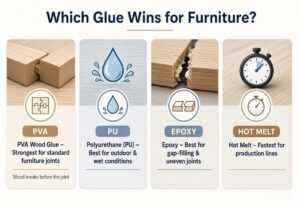
Comparison chart showing when to choose PVA, polyurethane, epoxy or hot melt adhesive for wood furniture joints.
When repairing wooden furniture, what kind of glue works best?
For repairing wooden furniture, PVA wood glue is best when the original joint is still tight and just needs re-gluing, since it bonds cleanly to bare wood. When a joint is loose, chipped, or has a gap, epoxy is the better repair glue because it fills space and cures into a hard, gap-tolerant bond.
A simple way to decide: if the two wood surfaces still fit together snugly, use wood glue and clamp it. If there is a gap, a missing chip, or the joint is loose and wobbly, use a two-part epoxy, since it will bond and fill at the same time — something wood glue cannot do well.
How to Glue Wood Together Permanently
To glue wood together permanently, clean both surfaces of dust and old glue, apply a thin, even layer of PVA wood glue to both sides, press the pieces together, and clamp them firmly for the time the glue manufacturer recommends — usually 30 minutes to 24 hours for a full cure.
A few things make the difference between a permanent bond and one that fails later:
- Clean, dry surfaces — oil, wax, dust, or old finish on the wood stops the glue from soaking in properly.
- Even glue coverage — too little glue starves the joint; too much just squeezes out and wastes material.
- Firm clamping — the joint needs steady pressure while it sets, not just a quick press.
- Full cure time — many joints feel solid within an hour but reach full strength only after 24 hours. Load the joint too early, and it will weaken.
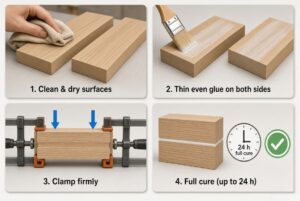
Step-by-step process showing how to glue wood furniture joints permanently: clean surfaces, apply thin PVA glue, clamp, and allow full 24-hour cure.
What Is Stronger Than Wood Glue?
Epoxy and polyurethane (PU) adhesives are generally stronger than standard PVA wood glue, especially for structural, outdoor, or gap-filling repairs. Epoxy cures into a rigid bond that can outperform wood glue on non-porous or uneven surfaces, while PU adhesive offers better water and heat resistance.
That said, “stronger” depends on the job. On a clean, well-fitted wood-to-wood joint, PVA wood glue is usually strong enough that the wood itself will fail before the glue does — so for standard furniture work, moving to epoxy or PU mainly makes sense when you need extra water resistance, gap-filling, or a faster structural cure.
What Is the Strongest Glue Brand and the Best Wood Glue in India?
In India, well-known PVA wood glue brands like Fevicol and similar carpenter’s glues are the most widely used for furniture joinery, while epoxy brands such as Araldite are the common choice for gap-filling or structural repairs. For furniture manufacturers and woodworking businesses, though, the more relevant question is not which retail brand to buy off the shelf, but which adhesive manufacturer can supply the right formulation — hot melt, water-based, or rubber-based — for a production line.
This is where a dedicated adhesive manufacturer becomes important. Super Bond Adhesives, based in Thane and manufacturing adhesives in India since 1974, supplies woodworking adhesive ranges across all three major categories — hot melt, water-based, and rubber/contact-based — so furniture and woodworking manufacturers can choose the right adhesive for their specific process rather than adapting a retail glue to an industrial line.
What Is the World’s Strongest Glue?
There is no single “world’s strongest glue” that wins in every situation — strength depends on the materials being bonded and the type of load the joint carries. For raw strength on metal and hard, non-porous surfaces, structural epoxies and cyanoacrylate (super glue) formulations are usually cited as the strongest. For wood specifically, a correctly applied PVA wood glue joint is strong enough that the wood itself typically breaks before the glue bond does, which is effectively the practical limit of “strength” for that material.
In short: the strongest glue is the one matched correctly to the surface, the load, and the environment — a rule that applies to furniture adhesives just as much as industrial ones.
What Makes Wood Glue Stronger?
Wood glue gets its strength mainly from how well it penetrates the wood fibres on both surfaces before it cures — the deeper and more even the penetration, the stronger the mechanical bond. Beyond the glue formula itself, three factors have the biggest effect on final joint strength:
- Surface preparation — a clean, slightly rough surface lets the glue soak in better than a smooth, sealed, or dusty one.
- Clamping pressure and time — steady pressure keeps the wood fibres and glue in close contact while the bond forms.
- Correct glue quantity — a thin, even coat bonds better than a thick, uneven one, which can trap air or take longer to cure.
Wood moisture content and room temperature during application also affect the cure, which is why furniture manufacturers running high-volume production usually control these conditions closely on the assembly line.
What Is the Best Instant Glue for Wood?
For an instant bond on wood, cyanoacrylate glue (commonly called “super glue” or “instant glue”) sets in seconds and works well for small repairs, tight-fitting joints, or holding pieces in place before a stronger adhesive is added. In furniture manufacturing, hot melt wood adhesive serves a similar “instant” role at production scale — it sets within seconds of application, which is why it is widely used for edge banding, veneering, and quick-assembly steps on a furniture line.
The difference is scale and purpose: cyanoacrylate is suited to small, precise, one-off bonds, while hot melt adhesive is built for continuous, high-speed application across many pieces on an industrial line.
Choosing the Right Adhesive Manufacturer for Furniture Production
For a single repair or a home furniture project, a good PVA wood glue or epoxy from a hardware store does the job. For furniture manufacturers and woodworking businesses running a production line, the bigger decision is choosing an adhesive manufacturer that can supply consistent, industry-tested formulations at scale — rather than relying on retail glue.
Super Bond Adhesives has been manufacturing adhesives in India since 1974, supplying woodworking adhesive ranges across hot melt, water-based, and rubber-based categories to furniture and woodworking manufacturers. If you are setting up or upgrading a furniture assembly line, reach out to the Super Bond team to find the right adhesive for your process.
Blog – https://superbond.co.in/hot-melt-adhesive-uses-strength-buying-guide/
https://superbond.co.in/what-is-the-best-adhesive-for-wood-in-india-an-honest-guide/
https://superbond.co.in/best-adhesive-for-wood-in-india-what-actually-makes-a-furniture-joint-hold/