

Hot Melt Adhesive Manufacturers in India: The Complete Buyer’s Guide
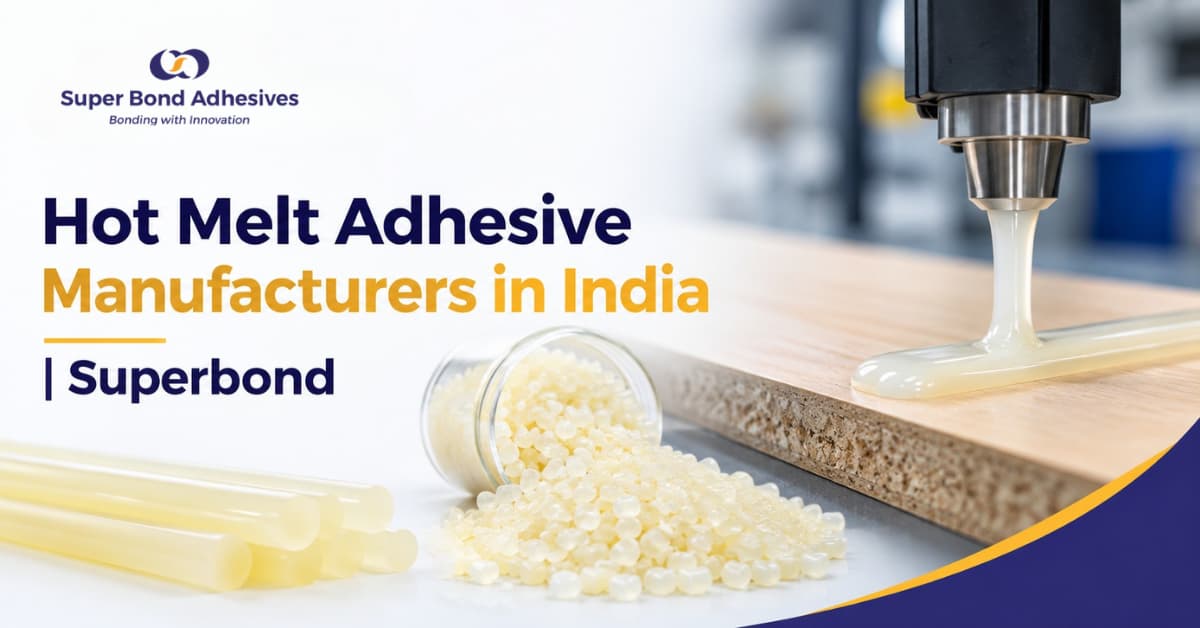
Hot melt adhesive manufacturers in India produce solid thermoplastic adhesives that melt on heating and bond instantly on cooling, used across packaging, woodworking, bookbinding, hygiene, and automotive industries. Super Bond Adhesives, manufacturing hot melt adhesives in India since 1974, is one of the country’s established producers, running three plants near Mumbai with a combined annual capacity of roughly 70,000 metric tonnes. This guide answers the questions buyers and users ask most about hot melt adhesive — what it sticks to, how strong it is, where it fails, and what to use instead when it isn’t the right fit.
Key Takeaways
- Hot melt adhesive bonds wood, paper, cardboard, fabric, and many plastics, but it isn’t a universal glue — it struggles on oily, very flexible, or high-heat surfaces.
- Standard EVA hot melt is not truly waterproof; it resists occasional moisture but softens under prolonged water exposure or heat.
- Bond strength depends heavily on adhesive grade, substrate, and application technique — mistakes in temperature or open time are the most common cause of weak bonds.
- For structural, outdoor, or high-load bonds, alternatives like polyurethane (PUR) hot melt, epoxy, or construction adhesives outperform standard hot glue.
- Super Bond Adhesives, an Indian hot melt adhesive manufacturer since 1974, supplies EVA, PUR, HMPSA, and polyolefin-based formulations engineered for specific industrial applications rather than one-size-fits-all bonding.
Who Are the Leading Hot Melt Adhesive Manufacturers in India?
India’s hot melt adhesive industry serves packaging, graphic arts, bookbinding, labels, tapes, hygiene products, and woodworking. Buyers typically look for manufacturers with in-house formulation capability, consistent batch quality, and industry-specific product lines rather than a single generic glue stick.
Super Bond Adhesives, established in 1974 and headquartered in Thane near Mumbai, is one such Indian manufacturer. The company operates three production plants dedicated to the graphic arts, packaging, tapes and labels, and rubber industries, with a combined manufacturing capacity of around 70,000 metric tonnes a year. Its product range spans standard EVA hot melts, hot melt pressure-sensitive adhesives (HMPSA) for hygiene and labelling, and polyolefin-based adhesives — a category the company has positioned as an alternative to conventional EVA and PUR systems. Buyers evaluating manufacturers should look for this kind of application-specific depth rather than a single all-purpose formulation.
Does Hot Glue Work on Wood?
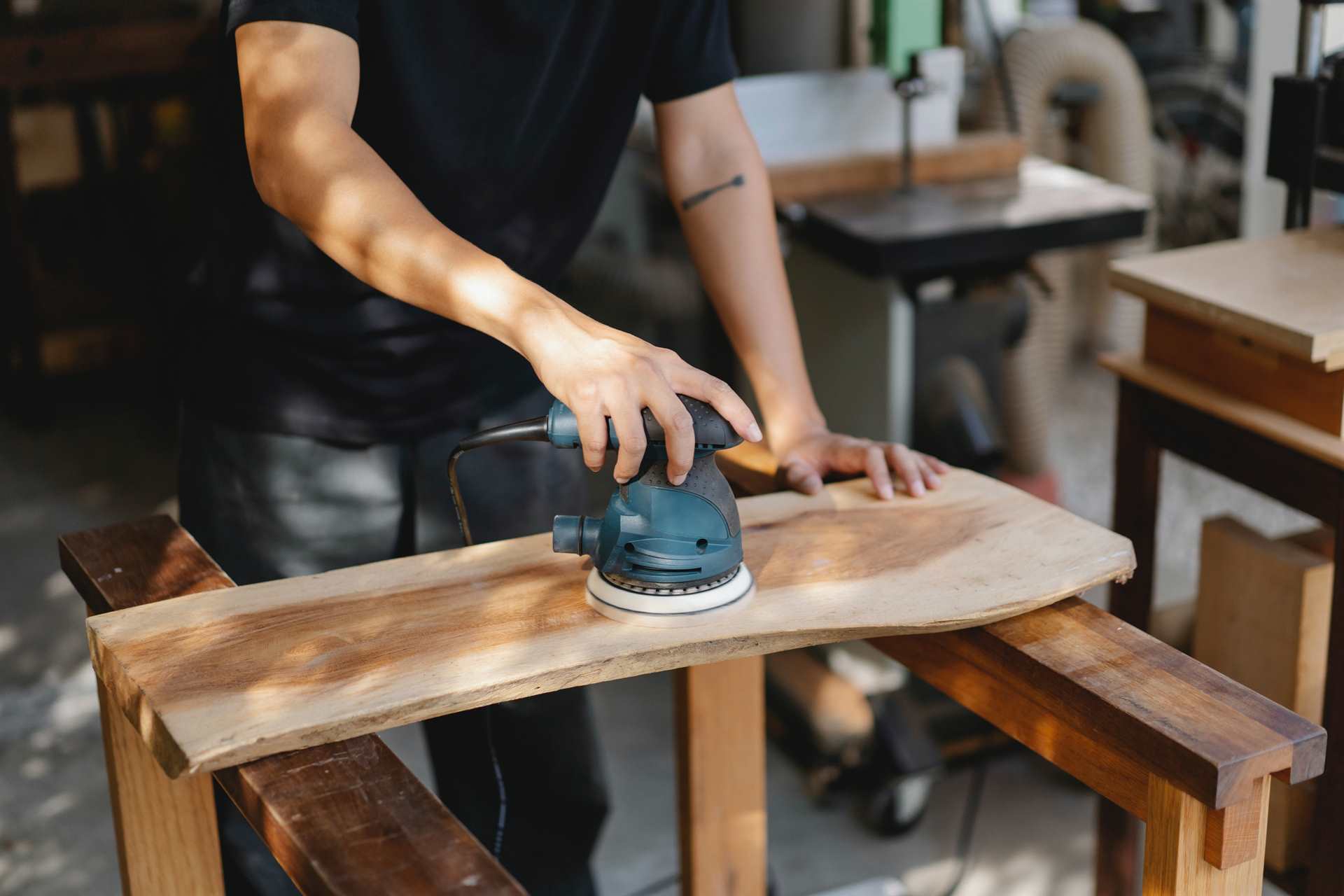
Yes, hot glue works on wood for light to medium-duty bonding, but it is not a substitute for wood glue (PVA) or construction adhesive on load-bearing joints. It bonds quickly by mechanically gripping the wood’s porous surface rather than penetrating and curing into it the way PVA glue does.
This makes hot melt adhesive useful for quick assembly, temporary positioning, trim work, and craft or model-making on wood. For joints that carry weight, flex under load, or need long-term structural strength — furniture joinery, load-bearing frames, outdoor woodwork — a PVA wood glue or a dedicated woodworking hot melt formulated for higher bond strength and heat resistance is the better choice.
Is Hot Melt Glue Waterproof?
Standard EVA hot melt glue is water-resistant, not fully waterproof. It can tolerate brief or occasional contact with moisture without failing, but prolonged soaking, high humidity, or hot water will soften the bond over time and eventually cause it to release.
The reason comes down to chemistry: EVA (ethylene-vinyl acetate) hot melt has a relatively low softening point, and water combined with heat accelerates that softening. For applications that genuinely need to survive wet conditions — outdoor use, packaging exposed to condensation, or products washed repeatedly — manufacturers typically recommend polyolefin-based or PUR hot melt adhesives, which hold up significantly better under sustained moisture and temperature swings.
What Is Hot Melt Glue Not Waterproof For — and What Material Will It Not Stick To?
Hot glue does not bond well to a specific set of materials regardless of moisture: oily or greasy surfaces, silicone, PTFE (Teflon), wax, very flexible or rubbery plastics like polyethylene and polypropylene, powder-coated or textured metal, and freshly painted or sealed surfaces where the glue only grips the coating, not the substrate underneath.
The common thread is surface energy. Hot melt adhesive bonds by wetting a surface and mechanically keying into it as it cools; materials with low surface energy (oily, waxy, or slick plastics) or surfaces that flex more than the cured glue can absorb tend to shed the bond under stress. For these substrates, a specialty adhesive formulated for that specific material — or a surface pre-treatment such as flame treatment or a primer — is usually required.
What Is Hot Melt Glue Commonly Used For?
Hot melt adhesive is most commonly used in case and carton sealing, product assembly, bookbinding, labelling, woodworking, textile and nonwoven bonding, and hygiene product manufacturing (such as sanitary pads and diapers). Its main advantage across all of these is speed: it sets in seconds without needing a curing period, which makes it a natural fit for high-speed production lines.
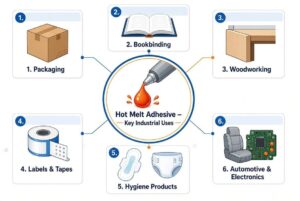
Industry-specific use cases include:
- Packaging — carton sealing, case erecting, and tray forming on automated lines
- Graphic arts and bookbinding — perfect binding, lamination, and case-making
- Woodworking — edge banding, veneering, and panel assembly
- Labels and tapes — pressure-sensitive labelling and tape lamination
- Hygiene products — construction, core, positioning, and wing adhesives in sanitary pads and diapers
- Automotive and electronics — component potting, wire tacking, and interior trim assembly
How Do You Apply Hot Melt Adhesive?
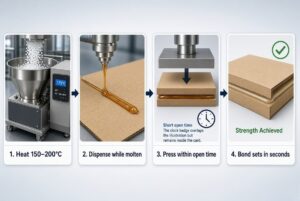
Hot melt adhesive is applied by heating it in a glue gun or an industrial melter to its working temperature (typically 150–200°C, though low-melt formulations run cooler), then dispensing it onto the substrate while molten and pressing the two surfaces together before it cools and sets — usually within seconds.
For consistent bonds, three factors matter most: temperature (too cool and the glue won’t wet the surface; too hot and it degrades or scorches sensitive materials), open time (the short window between application and cooling in which the bond must be pressed together), and coverage pattern (a bead, spray, or slot pattern suited to the substrate and required strength). Industrial lines typically use automated hot melt applicators with programmable temperature and pattern control, while manual applications rely on handheld glue guns for lower-volume or craft work.
How Strong Is Hot Melt Adhesive?
Hot melt adhesive bond strength varies widely by formulation, ranging from light-tack pressure-sensitive grades used in labelling to high-strength structural grades used in packaging and woodworking that can exceed the tensile strength of the substrate itself. Standard EVA hot melt typically delivers moderate strength suited to packaging and assembly; PUR hot melt cures further through moisture exposure and reaches substantially higher, more durable bond strength over time.
Strength in practice depends on more than the adhesive grade — substrate porosity, surface preparation, applied temperature, and the amount of adhesive laid down all affect the final bond. A correctly applied hot melt bond on a suitable substrate is strong enough for permanent product assembly; the same adhesive on an unsuitable surface or with poor application technique can fail well below its rated strength.
What Are the Disadvantages of Hot Melt Glue?
Hot melt glue’s main disadvantages are a short open time that leaves little room for repositioning, sensitivity to heat and prolonged moisture that can cause bond creep or failure, limited effectiveness on low-surface-energy plastics and oily materials, and the burn risk that comes with working at high application temperatures.
Other practical limitations include visible glue strings or “stringing” if the equipment isn’t tuned correctly, the need for a melter or glue gun rather than simple room-temperature application, and reduced flexibility at low temperatures, which can make bonds brittle in cold environments. None of these rule out hot melt as an option — they simply define where a different adhesive chemistry, such as PUR, epoxy, or a solvent-based adhesive, is the more appropriate choice.
What Are Common Hot Glue Mistakes?
The most common hot glue mistakes are applying it at the wrong temperature, waiting too long before pressing surfaces together, using too little or too much adhesive, gluing dusty or oily surfaces without cleaning them first, and choosing a general-purpose glue stick for a job that needs a specialty formulation.
- Wrong temperature — too cool and the glue skins over before it bonds; too hot and it can warp or discolor delicate materials
- Missing the open time window — pressing surfaces together after the glue has started to set produces a weak, superficial bond
- Uneven adhesive coverage — too thin starves the bond; too thick creates excess squeeze-out and a longer cooling time
- Skipping surface prep — dust, oil, or moisture on the substrate prevents proper wetting and adhesion
- Using the wrong grade — a standard craft glue stick on a load-bearing or outdoor application will underperform regardless of technique
How Long Will Hot Glue Hold?
A correctly applied hot glue bond on a suitable substrate can hold indefinitely under normal indoor conditions, since the adhesive doesn’t chemically degrade on its own once cooled. In practice, longevity depends on the operating environment — bonds exposed to sustained heat above the adhesive’s softening point, repeated flexing, or continuous moisture will weaken over months rather than lasting indefinitely.
For products expected to endure heat cycling, outdoor exposure, or mechanical stress over years, manufacturers generally specify a higher-performance formulation — PUR or polyolefin-based hot melt — rather than relying on standard EVA grades to hold long-term.
What Is the Strongest Hot Glue Stick?
Among glue-stick-format adhesives, high-strength or “heavy-duty” hot glue sticks — typically higher-viscosity EVA or specialty polymer blends sold for construction, crafts, and general repair — offer the strongest bonds available in stick form, generally outperforming standard low-temperature or dual-temperature craft sticks. Even so, glue sticks as a category are bounded by what a handheld glue gun can melt and dispense; for genuinely high-strength or structural bonding, industrial hot melt adhesive supplied in pellet, slug, or bulk form to a proper melter and applicator system delivers materially higher and more consistent strength than any stick-format product.
Hot Glue Alternatives: Substitutes, Stronger Options, and Comparisons
Hot glue is one option among several adhesive chemistries, and the right substitute depends on what the standard formulation can’t do for a given job — whether that’s strength, water resistance, flexibility, or working time.
What Is the Best Substitute for Hot Glue?
The best substitute depends on the job: PVA (wood) glue for porous materials needing a strong permanent bond, epoxy for structural or gap-filling repairs, cyanoacrylate (“super glue”) for small precision bonds, and construction adhesive for heavy-duty building applications. Each trades hot glue’s speed for greater strength, water resistance, or working time.
What Is the Strongest Waterproof Adhesive?
Two-part epoxy and polyurethane adhesives are generally considered the strongest waterproof adhesive options for general use, curing into a rigid, fully water-resistant bond that withstands prolonged submersion and temperature extremes far better than standard hot melt or contact adhesives. Marine-grade epoxy and PUR sealant-adhesives are the typical choice for outdoor, marine, or continuously wet applications.
What Is Stronger Than Hot Glue?
Epoxy, polyurethane adhesive, and cyanoacrylate all generally exceed standard hot melt glue in bond strength, particularly on non-porous or load-bearing joints. Within the hot melt category itself, PUR hot melt is significantly stronger and more heat- and moisture-resistant than standard EVA hot melt.
What’s an Alternative for Hot Glue?
Depending on the application, common alternatives include PVA glue for wood and paper, contact cement for laminate and large flat surfaces, double-sided tape for clean temporary bonds, and spray adhesive for large or delicate surfaces where a hot glue gun’s precision isn’t practical.
What Is Better, Gorilla Glue or Hot Glue?
Neither is universally better — they serve different purposes. Hot glue sets in seconds and works well for quick assembly and crafts, while Gorilla Glue (polyurethane-based) takes longer to cure, expands slightly as it sets, and produces a stronger, more water-resistant, permanent bond suited to structural repairs and outdoor use.
What Is the Best Heavy-Duty Adhesive?
For heavy-duty bonding, two-part epoxy, polyurethane construction adhesive, and PUR hot melt are the standard choices, selected based on whether the job needs gap-filling strength (epoxy), flexibility and moisture resistance (PUR), or high-speed industrial assembly (PUR hot melt).
What Is the Strongest Adhesive You Can Buy?
Among commercially available adhesives, structural epoxies and cyanoacrylate-based industrial adhesives typically deliver the highest tensile and shear strength for general bonding. For industrial manufacturing specifically, high-performance PUR hot melt and reactive adhesives are engineered to match or exceed epoxy-level strength while retaining the fast processing speed hot melt systems are chosen for.
Choosing the Right Hot Melt Adhesive Manufacturer
Bond strength, waterproofing, and durability ultimately come down to selecting the right adhesive grade for the application — which is why working directly with a manufacturer that formulates for specific industries, rather than buying a generic hot melt product, makes the biggest difference in production outcomes.
Super Bond Adhesives has been manufacturing hot melt adhesives in India since 1974, with dedicated formulations across packaging, graphic arts, bookbinding, labels and tapes, woodworking, and hygiene product manufacturing — including EVA, PUR, HMPSA, and polyolefin-based adhesive ranges produced across its three plants near Mumbai. For manufacturers evaluating a hot melt adhesive supplier in India, get in touch with the Super Bond technical team to identify the right grade for your substrate and production line.
Blog – https://superbond.co.in/hot-melt-adhesive-uses-strength-buying-guide/
https://superbond.co.in/what-is-the-best-adhesive-for-wood-in-india-an-honest-guide/
https://superbond.co.in/best-adhesive-for-wood-in-india-what-actually-makes-a-furniture-joint-hold/