







Applications, Size of Market, and Best Products for Industrial Hot Melt Adhesive
Introduction to Industrial Hot Melt Adhesive
What Are Industrial Hot Melt Adhesives?
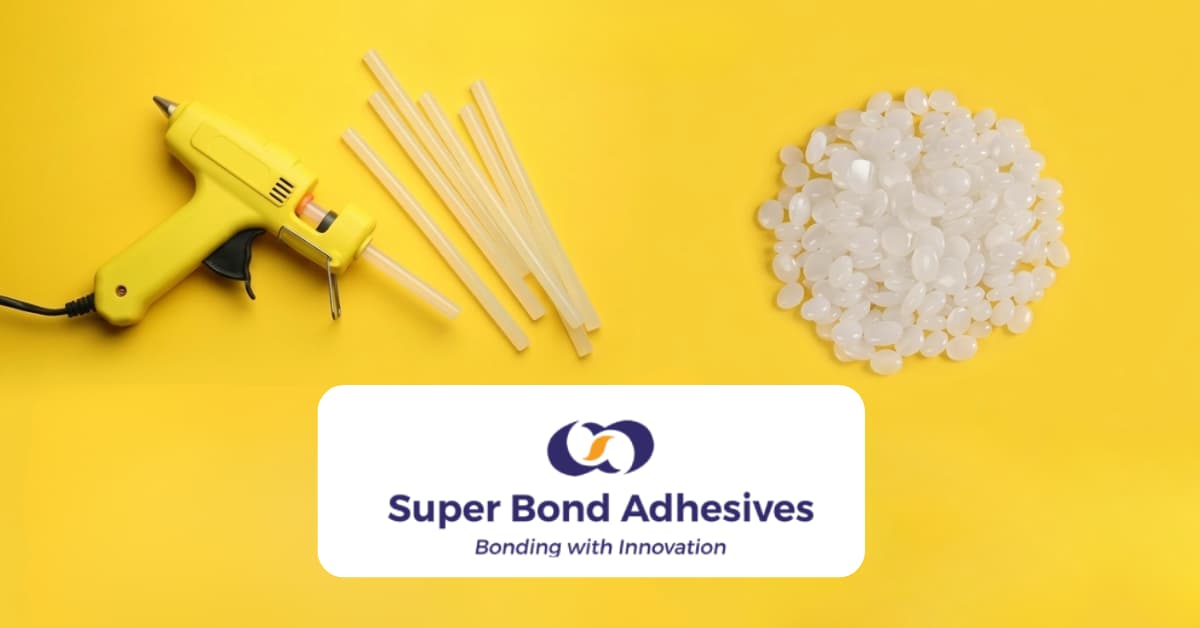
A hot melt adhesive is a solid material that is applied to the surface at normal temperatures. It is delivered in the form of pellets, blocks, granules, or sticks, based on the producer’s choice. Once the adhesive heats up and is applied to its base, its temperature drops to form a bond. There isn’t an intermediate drying process, nor is there evaporation of the film coating. As a result, the layer of adhesive will largely remain undisturbed. Production teams depend on this predictability.
Why hot-melt glue suits modern manufacturing
Taking solvents out of the process changes how a facility runs day to day. Ventilation demands drop. There’s no need to carve out floor space for curing tunnels. The equipment list gets shorter, and upkeep is less of a burden because nothing corrosive or volatile is moving through the system. If a bond fails during application, remelting and redoing it is often an option — most other adhesive systems won’t allow that.
How Industrial Hot-Melt Glue Works in Factories
Melting, application, and setting
Getting a clean run means keeping three things in check — temperature, coating weight, and press pressure. If even one of these were left to chance, you’d see issues almost instantly – a strand stretching out over the substrate, burnt glue inside the nozzle, or bonds that seem solid until something tugs on them. It’s simple, but it does take constant vigilance once the process begins.
Key performance properties to understand
Every engineer evaluating a new grade wants to know how it behaves at working temperature, how long it stays open, how quickly it sets, how much heat it can take, and whether it actually grips the substrates on their specific line. A hot melt glue formula created for use in the cold chain industry – meaning it remains flexible at temperatures below freezing – uses an entirely different chemical structure than one that withstands high temperatures and maintains its form when bearing weight.
What Is the Best Hot Melt Glue for Industrial Use?
What makes up the optimal hot melt adhesive
No single product works best across every situation. It all comes back to the substrate, the temperature range the joint has to hold through, the speed of the line, and what kind of stress the finished product sees in the field — whether that’s moisture exposure, physical impact, long-term load, or a mix of all three. A grade that performs perfectly sealing cartons in a room-temperature warehouse can break down completely in a freezer facility or a sun-exposed automotive component.
Matching hot-melt formulations to applications
Four kinds of adhesives are available for consumers. EVA resin-based glue is suitable for all packaging and assembly applications. It is affordable and can be utilized in both manual and automated processes. Polyolefin and PUR adhesives are used when stronger joints are required. For instance, they can cope with complex plastics, increased heat resistance, or long-lasting bonding for construction projects. Choosing between them takes actual line trials on your substrates. A spec sheet comparison only tells part of the story.
What Is the Size of the India Adhesive Market?
Size and future potential
The Indian adhesives market was estimated at INR 245 – 287 billion during the mid-2020s and is predicted to grow to reach INR 361 billion. On the dollar side, the adhesives and sealants segment was valued near USD 2.27 billion in 2025, with expectations of reaching USD 3.88 billion before the decade is out, close to 11% growth annually. The sectors driving it are construction, automotive, packaging, and woodworking, where more factories are replacing mechanical fastening with adhesive bonding as production processes modernize.
Role of industrial hot-melt in India’s growth
As organised manufacturing grows and e-commerce keeps pushing packaging volumes higher, hot-melt demand will follow. This technology is especially convenient for industrial manufacturing, as it is solvent-free and does not require a special curing phase, with the joint being formed by cooling alone.
Best Hot-Melt Adhesive Company for Industrial Applications
Criteria to choose the best hot-melt adhesive company
The things that actually matter when picking a supplier are fairly practical. You want a product that shows up performing the same way it did last time — no batch-to-batch surprises. You want people on the other end who know enough about your application to steer you toward the right grade, not just the most popular one. And you want formulations that don’t create equipment headaches. A supplier who can also help you fine-tune application temperature and coating weight is worth holding onto, because small adjustments there can cut adhesive consumption without touching bond quality.
Why specialised manufacturers like Superbond matter in India
Superbond develops its hot-melt range with Indian production environments in mind — local board grades, regional timber, domestic plastic types, and the humidity and temperature shifts that vary significantly across the country. When something goes wrong on the line, the difference between a local team that knows your materials and a distant overseas contact chasing email threads is measured in hours of downtime. Consistent results across multiple plant locations become a lot more achievable when the adhesive was built for those locations in the first place.
Industrial Applications and Practical Use Cases
Key industrial sectors using hot-melt adhesives
Packaging is the biggest user — carton sealing, tray forming, labelling, and flexible film packaging all depend on hot-melt to keep lines running at speed. Woodworking shops use it for edge-banding, panel lamination, and veneer applications. Book manufacturers rely on it for perfect binding. Outside those core areas, it turns up in building products, automotive interiors, hygiene goods, textiles, and general product assembly in ways most end users never notice.
Common production issues hot-melts help solve
Getting rid of solvents cuts a surprising amount of operational and administrative friction. Emissions compliance becomes simpler. Air handling systems don’t need to work as hard. The production floor itself is a cleaner, safer place to work. That’s before accounting for the processing benefits — no cure time holding up the line, precise metering keeping waste down, and fewer rejects coming off the end because the adhesive is being applied consistently rather than approximated.
Summary
Hot-melt adhesives are solid thermoplastics that bond on cooling — no solvents, no cure times, fast cycle throughput. They’re used across packaging, woodworking, bookbinding, automotive production, and many other sectors. India’s adhesives market is on a steady growth path toward 2030, with hot-melt playing a growing role in that expansion. The right product always comes down to substrates, operating environment, and equipment — and pairing that match with a supplier who understands Indian manufacturing conditions from the ground up is what delivers dependable results on the production floor.