

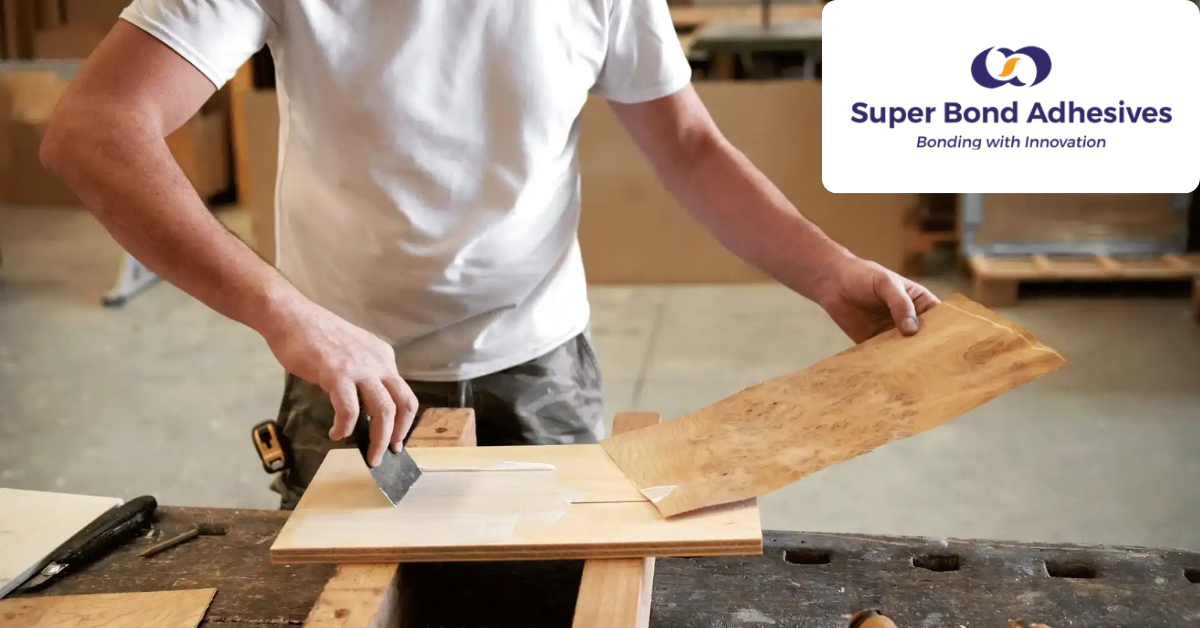
Best Adhesive for Wood
Superbond offers the best adhesive for wood binding, trusted among the woodworking community for strong furniture binding and upholstery. Replacing the need for mechanical fasteners like nails and screws, our wood furniture adhesives provide cleaner finishes, seamless joints, and durability.
Whether you are a professional wood product manufacturer or a furniture producer running a high-speed production line or a DIY enthusiast restoring an antique chair, choosing the best adhesive for wood often helps you achieve a masterpiece. Superbond has revolutionised wood adhesive manufacturing, offering a suite of advanced solutions from rapid-setting hot melts to eco-friendly water-based polymers.
In this post, we dive deep into the science of adhesion and explore why Superbond Adhesives has earned its reputation as the best adhesive for wood binding.
What defines the best adhesive for wood binding?
In professional woodworking and in industrial manufacturing, there is no one best adhesive for all scenarios. The best wood adhesive is defined by how well it fits the purpose, meaning how well the chemical and mechanical properties of a specific formulation fit the project’s structural requirements, environmental exposure, and assembly process.
Across the industry, however, the standard of the best adhesive for wood is measured against a wide array of technical characteristics.
A superior wood adhesive must excel in three core dimensions: mechanical performance, environmental durability, and operational workability.
-
Mechanical Performance
Mechanical performance refers to the bond strength. The bond strength is measured by substrate failure, which means that if you try to break a wood joint, the wood fibers should tear before the glue line snaps.
The bond strength is measured by:
-
Sheer Strength
Shear strength is the most critical metric while determining the strength of wood joint bonds. It measures the adhesive’s ability to resist sliding forces like the weight on a chair leg.
-
Creep Resistance
Creep Resistance is the tendency of a solid material to slowly move or deform permanently under mechanical stresses. The best adhesives for load-bearing furniture like chairs or shelving must have high creep resistance.
-
Gap-Filling Ability
Gaps exist in every wood joint. Gap filling is the ability of the adhesive to bridge those gaps without losing structural integrity.
2. Environmental Durability
Environmental durability measures an adhesive’s resilience to environmental factors like moisture, heat, humidity, and temperature swings, ensuring bond integrity over time.
3. Operational Workability
Finally comes the production efficiency. The adhesive should maximise production efficiency. Here are some of the factors that measure production efficiency.
- Open vs Closed Assembly Line
Open time refers to how long the glue remains wet before you join the parts. Complex assemblies require a slow-set glue with a long open time so that the glue doesn’t dry before you finish.
Set time refers to how fast the adhesive grabs the substrates. A fast-set glue is best to unclamp parts quickly and move them to the next stage.
-
Viscosity
Viscosity determines the thickness of the adhesive or flow resistance, which determines its gap-filling ability, surface coverage, and drip prevention, which is critical for precision woodworking. Low-viscosity adhesives penetrate tight pores for invisible joints in fine joinery, while high-viscosity options are good for vertical surfaces as they do not drip and stay in place.
-
Cleanup and pH
The cleanup of the adhesive should be easy by just wiping off. They should not leave any residue behind. Acidic glues can react with tannins in wood like oak or walnut, leaving dark stains. The best adhesive for wood should often be low pH to prevent discolouration. The adhesive should be compatible with water cleanup for safety and ease of use rather than solvent cleanup.
When an adhesive ticks off mechanical strength, durability in varying environments, and workability in real-world production, it becomes more than just glue, it becomes a reliable partner.
Such adhesives reduce rejects, ensure longevity for wood products, simplify the assembly process, cut cleanup time, and maintain quality across batches.
Why is Superbond the best adhesive for wood binding?
Superbond rubber-based adhesives stand out as the best adhesive for wood binding because they are engineered to deliver:
- Exceptional bond strength
- Superior environmental performance
- Outstanding on-the-job workability
- Easy Cleanup and maintenance
-
Exceptional Bond Strength
With a high-technology water-based polymer system at the core, Superbond’s wood adhesives deliver exceptional performance. They are formulated using advanced PVA and other high-performance polymers. Each blend is engineered to work across hardwood, softwood, and engineered wood applications. These polymers ensure strong, durable bonds that withstand vibration, movement, humidity, and temperature variation without failure.
Superbond’s woodworking adhesives penetrate the porous structure of wood and form a continuous polymer film as the water carrier evaporates. This creates a robust mechanical and chemical bond that is stronger than the wood substrate itself, suitable for everything from fine furniture and decorative laminates to heavy‑duty industrial assemblies.
-
Superior Environmental Performance
By using water as the primary carrier instead of aggressive organic solvents, these formulations drastically improve safety. They achieve near-zero VOC (volatile organic compound) emissions.
This significantly reduces indoor air pollution and odour. It also lowers worker exposure to hazardous fumes. Going a step further, Superbond’s water-based adhesive solutions incorporate more than 30% plant based polymers, minimising ecological footprint.
The superior environmental performance of our wood adhesives allows manufacturers to align with modern sustainability goals and increasingly strict global environmental regulations. Non-toxic and non-flammable adhesives improve safety in workshops and factories, simplifying storage, handling, and waste management.
-
Operational Workability
Superbond’s water-based adhesives have long open times for accurate fitting and assembly, with fast set times to keep production lines running. Many of our formulations dry and develop handling strength in 20-30 minutes under normal room temperature conditions. This eliminates the need for heat curing and speeds up clamping and press cycles in both manual and automated lines. With additives such as thickeners and plasticisers to control viscosity and flow, the glue spreads evenly, giving clean glue lines.
-
Easy Application and Cleanup
The woodworking adhesives can be applied reliably by brushing, rolling, or squeezing without clogging equipment or drying prematurely, which is critical for high‑speed woodworking and furniture production. The cleanup of these adhesives is straightforward with water rather than harsh solvents, further reducing environmental impact.
Best Adhesive for Wood Binding: Understanding the Superbond Difference
Superbond provides three benefits, which include strong bonds, sustainable solutions, and an adhesive that meets all woodworking requirements. Wood binding adhesives require multiple essential characteristics that must be present at all times to determine their best solution. When you choose Superbond for your adhesive needs, you gain access to an established solution that enhances your craft work and ensures worker safety while protecting the environment and maintaining your business advantage against rising market challenges.
Transform your woodworking practice today by choosing Superbond woodworking adhesives.