
Best Adhesive for Wood in India
A furniture maker rang us last monsoon. He was baffled and a little angry.
His cabinets had cleared every check on the way out. Edge bands are clean. Laminate flat. Deliveries on time, which in this business is its own achievement. Then, about two months after installation, the phone started ringing. Drawer faces are peeling. Corners are working loose. Edge bands are always lifting near the sink.
Same timber supplier. Same workshop. The same men were doing the same work they had done for years.
One thing had changed. A bulk order had come up, the price was good, and he had switched adhesive.
The callbacks cost him several times what he saved.
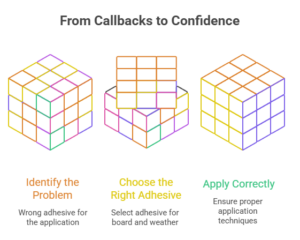
We hear a version of this every year, from furniture manufacturers, from carpenters, from modular kitchen suppliers. And it nearly always traces back to the same thing. The adhesive was wrong for the board, or wrong for the method, or wrong for the weather that the furniture was going to have to live through.
Superbond has been making woodworking adhesives in India since 1974. Our plant in Thane has been formulating for workshops, production lines, and industrial operations for over five decades. What follows comes out of that, not out of a textbook.
Why the Cheap Adhesive Is Usually the Expensive One
Nobody chooses the wrong glue on purpose.
The decision just gets made fast. What is on the shelf? What we used last time. What is the cheapest per litre? Twenty seconds, and on to the next thing.
The bill arrives later. Half a year later. After a monsoon. When a homeowner in a kitchen somewhere notices her cabinet door no longer closes flush, she picks up the phone.
Then count what a callback actually costs. Transport. Labour. Replacement material. And the quiet damage to a relationship with a client who will remember this the next time he places an order. Set that against the few rupees a litre you saved, and the arithmetic stops being close.
Specifying properly is not a luxury. It is just cheaper.
Here Is the Thing About Bond Strength
People outside the trade are always surprised by this one.
A properly cured wood adhesive, whether PVA, epoxy, or polyurethane, tests somewhere around 3,600 to 4,000 PSI. Which means the glue is not your weak point. Load that joint until something gives, and it is the timber that tears. Not the glue line.
That is not a sales pitch. It is baked into the test method. Under EN 205, the lab that classifies a wood adhesive records the wood-failure percentage next to every single result. The people who wrote the standard already knew where a good joint breaks.
So why do furniture joints fail? Three things have to line up. Get one of them wrong, and the strongest glue in the country will not save you.
The Three Things That Have to Line Up
The chemistry has to suit the board. Solid sheesham and a sheet of particleboard are not the same problem. MDF is not veneer-faced ply. Treat them as interchangeable, and you are already in trouble.
The surface has to be clean and ready. Dust from the sander. Oil off someone’s hands. Damp sitting in the grain. None of it, and the adhesive cannot get into the fibres to do its work. The finest glue in the world, spread on a dirty joint face, is just an expensive smear.
The formulation has to survive where the furniture ends up. A wardrobe in a Chandigarh office lives a very easy life. A kitchen cabinet in Mumbai does not. An adhesive that behaves impeccably in one can soften, swell, or let go in the other. In a country with our range of climates, this is the one people get wrong most often.
Durability Class: The Number Nobody in India Asks For
If you take one idea away from this guide, make it this one.
Stop asking which glue is strongest. They are all stronger than your wood. Start asking which durability class your conditions demand. That is the question with an answer.
What D1, D2, D3 and D4 Really Tell You
EN 204 is the standard that sorts thermoplastic wood adhesives into four classes by water resistance. D1 is at the bottom; D4 is at the top. The D is for durability. It says nothing whatsoever about strength.
|
Class |
Where it belongs |
What it is actually rated for |
|
D1 |
Dry interior |
Rarely above 50°C. Wood moisture up to 15%. Bedroom furniture, nothing more. |
|
D2 |
Interior | The odd splash. Occasional condensation. Wood moisture up to 18%. |
| D3 | Humid interior |
Regular short contact with water and sustained high humidity. Also, outdoor furniture that stays under cover. |
|
D4 |
Wet interior |
Frequent, prolonged contact with running or condensed water. Kitchens. Bathrooms. |
These are not stickers somebody prints. They are measured. To carry D3 under EN 204:2016, an adhesive has to still hold above 2 N/mm² after seven days in ambient conditions and then four days sitting submerged in cold water.
So when a supplier tells you his glue is D3, ask for the report. If he cannot produce one, he has not told you anything.
And While We Are Here: D4 Is Not “Waterproof”
The trade says waterproof. The standard does not. D4 is the highest durability class there is, and that is a different claim from being immune to water. Worth knowing the difference before you promise a client something.
Something else worth knowing. EN 204 deliberately says nothing about how the bond line behaves in heat. Temperature resistance is a separate test altogether, DIN EN 14257, which everyone calls WATT 91. So a D4 rating tells you about water and only water. If your joint is going to get hot as well as wet, you need two numbers, not one.
So What Does Indian Furniture Actually Need?
For a wardrobe in a dry climate, D2 genuinely does the job. No need to gold-plate it.
But India is not one climate, and this is where the honest answer parts company with the easy one. A kitchen cabinet anywhere near the coast. A bathroom vanity. A dining table that gets wiped down twice a day. Anything that ships through a monsoon and then sits in a godown waiting to be installed. That is D3 at minimum, and pretending otherwise is just deferring the problem.
And if the joint is going to meet standing water or long spells of condensation, go to D4 and do not argue about the price. Glue is the cheapest thing in that cabinet. Rework is not.
The Adhesives Indian Furniture Is Actually Built With
PVA: What Is Sitting on Every Bench in the Country
Walk into a carpentry workshop anywhere, a two-man unit in Moradabad or a proper furniture house in Hosur, and there will be a bottle of PVA on the bench. It is the default, and it deserves to be.
Water-based. Non-toxic. Easy to spread. Forgive if your hand is not steady. It does not cure by chemical reaction at all. It simply loses its water. As that water leaves, the adhesive draws tight and pulls the fibres together, and under the right conditions, the grip it forms is stronger than the timber holding it.
For indoor work on solid wood — chairs, tables, wardrobes, interior cabinetry in a dry room — PVA does the job and does it cheaply. It also stays open long enough to shift a piece into place, which anyone who has ever tried to close six joints at once will appreciate.
Then the monsoon arrives. When indoor humidity climbs and stays there, which in a coastal city or a badly ventilated flat is most of the year, PVA-bonded joints begin taking on moisture. The adhesive softens. A joint that felt rock solid in March starts moving in August. Kitchen cabinets near the steam go first, then the bathroom vanity, then anything left outdoors.
This is not a bad product. PVA was never built to sit in sustained damp. Putting it there is a specification error, and the glue gets blamed for a decision somebody else made.
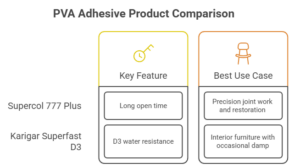
What do we make for this? Supercol 777 Plus is our PVA with a long open time, which is what you want for precision joint work and for restoration, where you need a moment to get the piece sitting right. Karigar Superfast D3 carries D3 water resistance, for interior furniture that will see the occasional damp without standing in it.
EVA Hot Melt: What Keeps a Production Line Moving
Every furniture factory in India has hot melt running somewhere, and the reason is simple. It sets as it cools. Almost instantly. There is no clamp, no wait, no floor space given over to curing racks. On a line where profit is a function of output per shift, that is not a convenience. It is the whole business model.
EVA is what most Indian lines run for edge banding, profile wrapping, and panel lamination. It goes down cleanly through automated equipment and behaves itself on high-speed straight-line banding, taking PVC, ABS, and melamine trims onto MDF and particleboard cores without stopping the machine every twenty minutes.
Our Super Melt range covers this ground. Super Melt 101 and 103 are the EVA grades for PVC and ABS edge banding on particleboard and MDF, by roller or nozzle. Super Melt 104 and 108 bring more cohesive strength and better thermal stability when temperature swings are part of the job.
Where EVA stops working. EVA does not crosslink. Once it has cooled, the bond it has made is physical, not chemical, and that is the whole story. Leave it in humidity long enough — next to a kitchen sink, in a coastal bathroom, through one outdoor monsoon — and the glue line takes on moisture and eventually gives up. Nothing broke. It just went soft.
For those places, EVA is simply the wrong specification. You want PUR.
PUR Hot Melt: When It Has to Hold, Wet or Dry
PUR — polyurethane reactive hot melt — is a different animal.
It cures twice. First, it cools and sets, giving you the same fast handling strength any hot melt gives. Then it goes to work chemically, crosslinking with the moisture already present in the air and in the wood itself. The isocyanate groups react with hydroxyl groups in the timber and build a crosslinked network through the joint. The result resists water because of what it is, not because of something painted over it.
For kitchen cabinets living in steam, for bathroom furniture, for outdoor pieces, for any home on the coast where the air stays heavy for months at a stretch, PUR is not an upgrade you might consider. It is the correct answer, and everything else is a compromise you will hear about later.
MC1 PUR, in our wood furniture range, forms bonds stronger than the wood around it. Chair frames are taking the load. Big cabinet assemblies. Structural panel joinery, where a failure after installation is not something you can talk your way out of. That is what people reach for it for. Super Melt 122N does similar duty in high-stress furniture work — cabinet construction and chair assembly — where the line has to move fast, and the bond still has to hold.
EVA or PUR: The Straight Comparison
|
EVA hot melt |
PUR hot melt |
|
|
How it sets |
Cools and hardens. That is all. | Cools, then chemically crosslinks with moisture in the air and the wood. |
|
Against moisture |
Holds up indoors. Gives way under sustained damp. |
Built for it. Handles direct water exposure. |
|
Bond strength |
Plenty for standard production furniture. |
Stronger than the timber around the joint. |
|
Where it belongs |
Indoor edge banding. Dry-climate production lines. |
Kitchens, bathrooms, outdoor pieces, anything coastal. |
|
On the machine |
Standard equipment. Forgiving. |
Sealed containers and real discipline about maintenance. |
| The cost | Cheaper per kilo. |
Dearer per kilo. Cheaper than a callback. |
Rubber-Based Contact Adhesives: For When the Joint Has to Move
These work on an entirely different principle. Coat both faces. Wait for the tack to come up. Press them together, and the bond happens on contact. No clamps, no waiting, which matters enormously when clamping time is what is throttling your output.
But the real reason to specify them is flexibility. They stay flexible after they cure, and for certain jobs, that is not a nice-to-have. It is the entire point.
Because wood moves. In this country, it moves a great deal. From July humidity to November dryness, timber swells and shrinks across a range that a rigid glue line cannot always follow. Bond a laminate to a door with something rigid, run that door through three monsoons, and stress piles up at the interface until something has to give. That is your edge lifting. That is your corner peeling. A rubber-based bond flexes with the wood instead of fighting it.
Where they earn their keep. Laminate onto doors, cabinet faces, panels — the bread and butter of it. Foam onto wooden sofa frames, chair bases, mattress platform edges, where a rigid bond would simply crack the first hundred times somebody sat down. And veneer onto engineered board, where a little give goes a long way.
SR7X is our formulation for antique restoration, where old timber moves more than new timber, and the joint has to accommodate that without splitting. SR9X takes wood to metal, which is what you need on hybrid furniture where brackets, inserts, and hardware sit alongside timber in the same frame.
The Indian Standards Nobody Mentions
Most wood glue guides written in this country skip this part entirely. That is a mistake, especially if you sell to institutional buyers, bid for government tenders, or export.
The Three That Apply
IS 4835 governs polyvinyl acetate dispersion adhesives for wood. That is the standard behind the PVA on most benches in India.
IS 851 covers synthetic resin adhesives for construction work in wood, non-structural.
IS 848 covers synthetic resin adhesives for plywood, phenolic, and aminoplastic.
Ask your supplier which one of his products conforms to. If he does not know, you have learned something about the supplier.
This Is Only Going to Tighten
BIS Quality Control Orders already set minimum performance for wood-based board — plywood, MDF, particle board. As certification tightens across the panel supply chain, the paperwork on what you glue those panels with gets pulled along behind it. Green building criteria push in the same direction, towards lower emissions and inputs you can actually document.
The file on your adhesive is going to matter more every year, not less. Better to have it now.

Four Questions That Settle the Decision
Where Is This Furniture Going to Live?
Bedrooms, offices, living rooms, a controlled indoor environment: PVA handles most joint work without complaint. Kitchens, bathrooms, coastal homes, anything outdoors: you need PUR or a properly water-rated adhesive. Specifying standard PVA in a monsoon is not a saving. It is an invoice with a delay on it.
What Is the Board, and How Are You Working?
Solid timber takes PVA well when the room stays dry. MDF and particleboard want a hot melt or a rubber-based adhesive with real initial tack. Mixed assemblies — laminate and PVC trim, ABS banding, and metal hardware all in one piece — want PUR or a rubber-based contact adhesive.
And your method decides as much as your material. A workshop with clamps and time gets everything PVA has to offer. An automated line where output per shift is the business’s need needs EVA. Production where moisture resistance and structural strength are both non-negotiable needs PUR, and there is no substitution to be made.
What Is the Joint Actually Being Asked to Do?
Light interior joinery, decorative panels: PVA or EVA. Standard assembly and edge banding: EVA. Chair frames, structural cabinet work, anything load-bearing: PUR.
Five Mistakes That Come Back as Callbacks
Most adhesive failures in Indian furniture are not the adhesive failing. They are things done wrong at the bench, before the glue ever had a chance, and no formulation on earth can compensate for them.
The Five, in Order of What They Cost
- Gluing onto a dirty face. Sanding dust, oil on a palm, and damp sitting in the grain. Any of it, and the bond is compromised before it forms. Clean and dry is not preparation. It is the foundation.
- Putting on more glue than the job needs. A thicker line is not a stronger line. A thin, even coat on both faces is the standard, and going heavier gives you a more brittle interface and a larger bill. Two losses for the price of one.
- Rushing the cure. Handling strength at thirty minutes is not full strength at thirty minutes. Our wood adhesives reach full bond strength over 24 to 72 hours, depending on the product and the weather that week. Move the piece before then, and you are shipping a joint that has never actually reached the strength you paid for. It will feel fine. It is not fine.
- Using PVA where water is part of the job. Kitchen and bathroom furniture, bonded with ordinary PVA, in a coastal city, through a monsoon. These fail. Reliably. D3, D4, or PUR is the answer, and there is no clever way around it.
- Putting EVA outdoors. It does not crosslink, so sustained humidity gets into the glue line and stays there. Outdoor furniture in India wants PUR hot melt. You cannot fix this with technique, and you certainly cannot fix it by using more.
In short, there is no best glue, only the Right One
The best adhesive for wood in India is not a brand and never was. It is a match. Chemistry to board, method to workshop, formulation to the weather that furniture is going to have to survive.
PVA for indoor joints in solid timber, where the room is stable, and you have clamps and time. EVA hot melt for the production of furniture, where output is the constraint and the environment stays dry. PUR for kitchens, bathrooms, the coast, and anything that goes outside. Rubber-based contact adhesives where the laminate has to stay stuck to a panel that will not stop moving.
The wrong choice never announces itself on the day. It shows up half a year on, when a joint cracks under load, or an edge band lifts after the first humid summer, and a client you have had for years starts wondering about you.
Get it right at the specification stage. It costs less, it builds better furniture, and it puts an end to the callbacks that quietly eat a margin nobody can see disappearing.
We have been helping India’s furniture trade make this decision since 1974. If you are weighing options for a particular job, our technical team will talk it through with you. No pitch attached.
[See our wood furniture adhesive range →] | [Talk to our technical team →]
Questions We Get Asked
On Strength, Water, and Standards
What is the strongest glue for wood furniture in India?
MC1 PUR forms a bond that outlasts the wood around it, so the timber gives before the glue does. For structural furniture, chair frames, and load-bearing cabinet work, that is the specification.
Is PVA waterproof?
No. It will shrug off a splash, but it is not built for sustained exposure. Kitchen, bathroom, and outdoor work needs a D3 or D4-rated adhesive, or PUR.
What do D1, D2, D3 and D4 mean?
They are durability classes under EN 204, ranked by water resistance. D1 is for dry interiors only. D2 copes with occasional condensation. D3 is water-resistant and handles humid interiors and covered outdoor use. D4 is the top class for frequent and prolonged water contact. Note that D4 does not mean waterproof, whatever the trade tells you.
Which Indian Standard applies to wood adhesive?
IS 4835 for PVA dispersion adhesives for wood. IS 851 for non-structural synthetic resin adhesives in wood. IS 848 for plywood adhesives.
On Products and Applications
What works best on MDF and particleboard? EVA hot melt is the Indian industry standard for MDF edge banding and panel assembly. Where humidity is a factor — kitchens, the coast, anywhere that catches the monsoon — PUR hot melt is what protects the bond over time.
What is best for edge banding? EVA hot melt. Super Melt 101 and 103 are made for PVC, ABS, and melamine trims on MDF and particleboard, by roller or nozzle, on manual and automated lines alike.
Can I use a rubber-based adhesive for laminate? Yes, and often you should. Contact adhesives suit laminate on panels, doors, and cabinet faces, and their post-cure flexibility is exactly what you want on a surface that will swell and shrink through the seasons.
What should I use for furniture repair and restoration? Supercol 777 Plus, for the long open time, which gives you room to get the piece sitting right before it grabs. For antique work, where old timber moves more than new, SR7X and its post-cure flexibility are the better call.