

Sanitary Pad Adhesive: What It Does, What BIS Demands, and How to Buy It
Here’s something most people in this trade don’t realise. When BIS tests a sanitary napkin, it doesn’t only test absorbency and pH. It tests adhesive strength. The glue isn’t hiding somewhere in the bill of materials. It’s on the examiner’s list.
That single fact should change how you buy it.
Key Takeaways
- IS 5405:2019 covers absorption capacity, pH, microbial load, barrier protection, and adhesive strength. Your glue is a tested parameter, not a background input.
- The ISI mark has been mandatory since 1 January 2025 for large and medium manufacturers, and 1 April 2025 for small and micro ones.
- Penalties run to seizure, fines, licence suspension, and up to two years in prison.
- A pad uses four glues, not one. Construction, core fixation, positioning, and wing.
- India’s sanitary napkin market was USD 894.49 million in 2025 and is forecast to reach USD 1,794.77 million by 2034. Maharashtra alone is 20% of it.
What Does Adhesive Actually Do in a Sanitary Pad?
A pad has no stitching and no fasteners. Layer on layer, held with glue, then one more layer of glue to hold the whole thing to a garment.
That last one is the interesting bit. Every other adhesive in the hygiene business bonds material to material inside a factory. The positioning glue on a pad has to bond your product to a stranger’s underwear, hold there for hours through movement and body heat, and then peel off cleanly without leaving a mark or pulling the fabric. It has to be gentle on skin and unforgiving on cotton, at the same time.
It’s the only glue in the hygiene category that a consumer physically interacts with. And when it fails, she doesn’t file a technical complaint. She switches brands.
Why the Market Is Worth Getting This Right
India’s sanitary napkin market stood at USD 894.49 million in 2025 and is forecast to reach USD 1,794.77 million by 2034, growing at just over 8% annually. Disposable pads are 72% of that. Pharmacies move 31% of it. And Maharashtra, on its own, accounts for 20% of the national market.
Penetration still has a long way to run. National family health data shows over 70% of urban women use sanitary napkins, against 48% in rural India. The gap between those two numbers is the growth story, and it’s mostly price-sensitive volume, which means every paisa of your cost-in-use will be argued over.
Which Adhesives Are Used in a Sanitary Napkin?
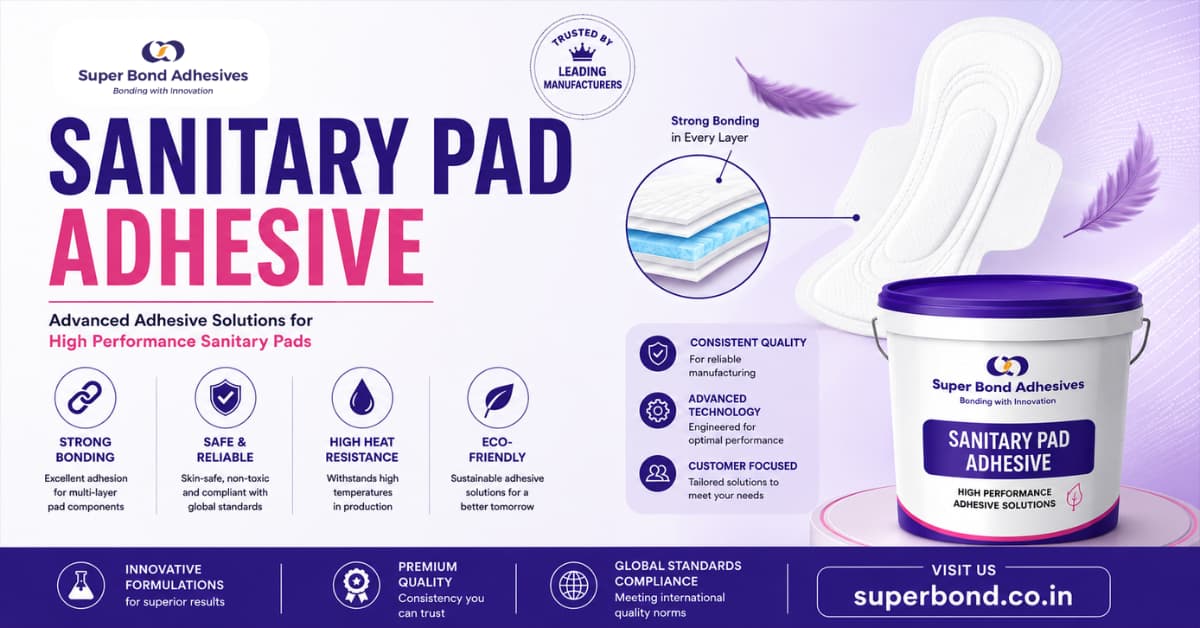
Four, broadly. Fewer than a diaper, because a pad has no leg elastics or waistband to hold. But the ones it does have are less forgiving.
| Adhesive | Where it goes | What you’re really buying |
| Construction | Topsheet to core to backsheet, layer on layer | Clean spray, no bleed-through, no bunching between layers |
| Core fixation | Holds pulp and SAP in place | Keeps the core stable under pressure, so it doesn’t shift or clump |
| Positioning | Garment-facing side, under the release paper | Peelable bond to underwear, no fabric damage, no staining, no irritation |
| Wing | The side flaps that fold under | A firm grip on the garment releases without tearing it |
The Positioning Glue Is the One That Decides Your Brand
Ask a supplier about positioning adhesive and listen for these, because they’re what separate a working grade from a returned pallet:
Cotton peel strength. It has to hold on cotton, on synthetics, on cheap fabric, and on expensive fabric. Garment textiles vary wildly, and your glue doesn’t get to choose.
No staining. Positioning glue sits against breathable PE and siliconised release material for months in a warehouse. A poor grade bleeds through and marks the product. The customer sees a stain on a hygiene product and draws her own conclusion.
Stability over storage. Performance has to hold after long storage, not just fresh off the line. In an Indian supply chain, a pad might sit through a full monsoon before it’s opened.
Low coat weight without losing grip. This is where your margin lives.
The Wing Adhesive Problem
Wings have to grip hard enough to stay folded under a garment through a working day, then let go without damaging it. Grip too hard and you tear someone’s underwear. Grip too softly and the wing lets go, and the pad shifts.
There’s no clever way around this. You trial it, on your line, on real fabric.
Is BIS Certification Mandatory for Sanitary Napkins in India?
Yes, and the deadlines have already passed.
The Rule, Plainly
Sanitary napkins were notified under the Medical Textiles (Quality Control) Order, 2024, issued by the Ministry of Textiles via S.O. 4634(E) on 23 October 2024. Under it, every disposable sanitary napkin manufactured, imported, or sold in India must carry a valid ISI mark against IS 5405:2019, Sanitary Napkins — Specification.
Enforcement started on 1 January 2025 for large and medium enterprises, and on 1 April 2025 for small and micro ones. Both dates are behind us.
Non-compliance isn’t a paperwork problem. It carries seizure of product, fines, licence suspension, and imprisonment of up to two years.
Why This Standard Is Different From the Diaper One
IS 5405:2019 sets out requirements for absorption capacity, pH, microbial load, barrier protection, and adhesive strength.
Read that last item again. The standard reaches directly into the glue. Adhesion isn’t inferred from a raw-material declaration somewhere upstream. It is measured.
That means a glue that runs beautifully on your line and still fails an adhesion test is a glue that costs you a licence. Spray pattern, coat weight, and machine speed are your problems. Adhesive strength is now BIS’s problem too.
Compliance Cascades Into Other Standards
Conformity to one Indian Standard tends to drag others along with it. Under IS 5405:2019, if cotton gauze is used as a raw material, it has to conform to IS 758. The pH test has to be run to IS 1390, which means the right equipment in your lab, or a lab that has it.
Budget for that. It’s the part that surprises small manufacturers.
What to Ask Your Adhesive Supplier For
Before a drum crosses your gate:
- Technical data sheet, with the application temperature window and viscosity curve
- Safety data sheet
- Skin-contact and biocompatibility declaration
- Adhesion and peel data on the substrates you actually run
- Test reports from a BIS-recognised or NABL-accredited lab
If a supplier can’t hand over adhesion data for a product where BIS tests adhesion, that tells you what you need to know.
How Do You Choose a Sanitary Pad Adhesive Supplier?
Trial It Against Real Fabric, Not a Sample Board
Run it at production speed for a full shift. Watch for stringing, for nozzles blocking by hour six, for char in the tank, and for bleed-through on the backsheet.
Then take the pad off the line and stick it to actual underwear. Cotton is a cheap synthetic. Leave it. Come back. Peel it. Look at the fabric.
That last test takes ten minutes, and it’s the one nobody does.
Test Aged Product, Not Fresh Product
Positioning adhesive that grips perfectly today can go hard, go tacky, or stain the release material after three months in a warehouse in Maharashtra in May. Pull product from stock, not from the line.
Buy Cost-in-Use, Not Price Per Kilo
Coat weight times price. That’s the number. A better positioning grade that holds at a lower add-on can beat a cheap one you’re forced to over-apply, and it does it while lowering your reject rate. Make every vendor quote cost-in-use at your target coat weight, on your line.
Super Bond capability paragraph. Insert only if accurate: which hygiene grades you formulate, application temperature range, adhesion data you can supply, and the documentation you can put in front of a BIS inspector.
conclusion
Sanitary pad adhesive is a small line in your costing sheet and a large part of your risk.
Four glues, four jobs. Construction, core fixation, positioning, and wing. Nobody makes one grade that does all four well.
The positioning glue is your brand. It’s the only adhesive your customer will ever touch. Get it wrong, and she doesn’t complain; she leaves.
BIS tests adhesive strength. IS 5405:2019 puts your glue on the examination table alongside absorbency and pH. Since 1 January 2025 for larger firms, and 1 April 2025 for smaller ones, that isn’t optional.
Trial on aged product, on real fabric. Everything else is a datasheet.
India will be buying a great deal more of these. The market is on its way from USD 894.49 million to nearly USD 1.8 billion, and rural penetration is barely at half of urban. The manufacturers who take that volume will be the ones whose pads stay put, peel clean, and pass the test.
FAQs
What adhesive is used in sanitary pads?
Hot melt adhesive. A pad typically uses four types: construction glue between the layers, core fixation glue to hold the pulp and SAP, positioning glue on the garment-facing side under the release paper, and wing adhesive on the side flaps.
Is BIS certification mandatory for sanitary napkins in India?
Yes. Under the Medical Textiles (Quality Control) Order, 2024, every disposable sanitary napkin must carry the ISI mark against IS 5405:2019. Enforcement began on 1 January 2025 for large and medium enterprises and on 1 April 2025 for small and micro ones.
Does IS 5405:2019 test the adhesive?
It does. The standard covers absorption capacity, pH, microbial load, barrier protection, and adhesive strength. Adhesion is directly tested, not inferred.
What is positioning adhesive on a sanitary pad?
It’s the glue on the garment-facing side, protected by release paper until use. It has to form a peelable bond with underwear that holds through wear, then releases without damaging the fabric or irritating skin.
What happens if I sell sanitary napkins without the ISI mark?
Penalties include seizure of product, fines, suspension of licence, and imprisonment of up to two years.
Why does positioning adhesive sometimes stain the pad?
A poorly matched grade can bleed through against breathable PE or siliconised release material during storage. Test aged stock, not product straight off the line.
How big is the sanitary napkin market in India?
USD 894.49 million in 2025, forecast to reach USD 1,794.77 million by 2034 at around 8% a year. Disposable pads are 72% of it, and Maharashtra is the largest state market at 20%.