
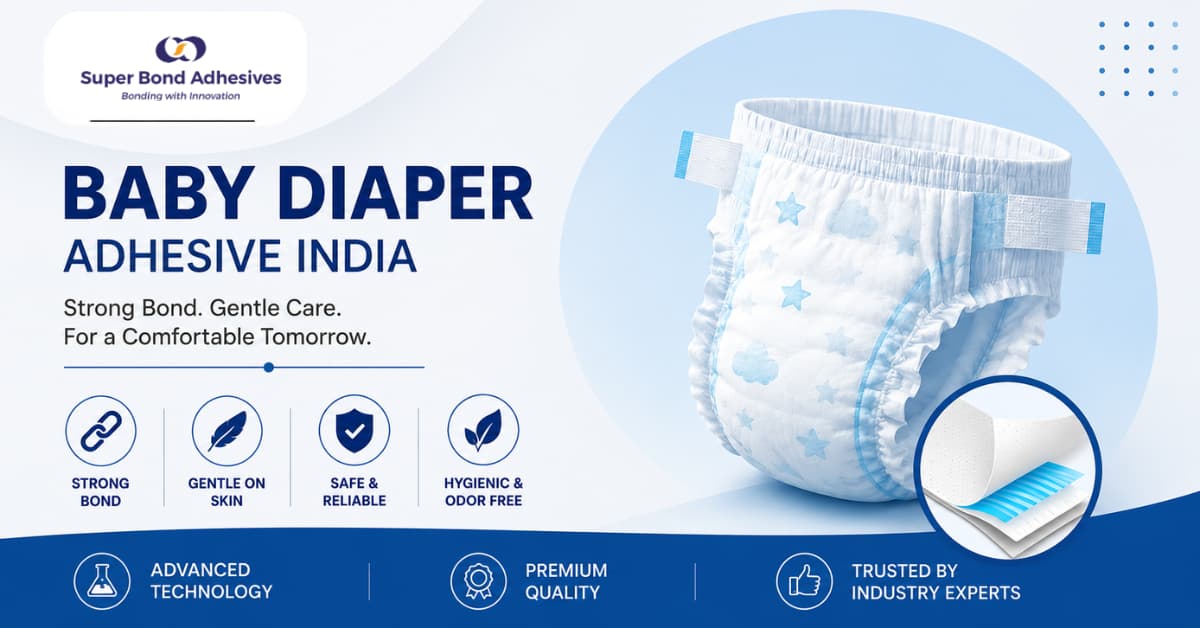
Baby Diaper Adhesive India: A Buyer’s Guide to Types, BIS Rules, and Suppliers
Almost every diaper made in India is put together with hot-melt glue. Not one glue, though. A single diaper needs several different grades doing several different jobs. And because BIS IS 17509:2021 reaches into your raw materials, the glue you buy is part of what gets certified. It isn’t just a shop-floor consumable.
Key Takeaways
- Glue is under 5% of what a diaper weighs. It still decides whether the thing leaks, whether it sags, and whether you clear your audit.
- India’s diaper market hit USD 1.83 billion in 2025 and is heading for USD 3.18 billion by 2034, growing 6.37% a year. Baby diapers are 88.09% of that.
- ISI certification under IS 17509:2021 is mandatory. No mark, no sale.
- Switch adhesive supplier, and you may trigger a fresh biocompatibility evaluation. Budget for it before you chase the discount.
- India’s hot melt adhesive market was around USD 234.7 million in 2023, forecast to grow 10% a year to 2030.
What Is Baby Diaper Adhesive, and Why Does It Matter So Much?
Pick up a diaper. Look for a stitch. There isn’t one.
Topsheet, absorbent core, backsheet film, leg elastics, side tabs. Every one of those layers is held on with glue. And here’s the part people find hard to believe: adhesives usually come to less than 5% of the total weight of a disposable hygiene product. Under a twentieth of it.
Get that twentieth wrong, though, and the core clumps up, the elastics give way, the tape peels off in the night, and a parent in Pune is posting a photo of a leaking diaper with your brand name on it.
We’ve watched converters agonise over SAP grade and nonwoven GSM while treating the glue as a line item to be squeezed. It’s a strange place to be casual.
The money says so too. India’s diaper market reached USD 1.83 billion in 2025, and it’s forecast to hit USD 3.18 billion by 2034, growing 6.37% a year, with baby diapers taking 88.09% of the product-type share. Roughly 25 million babies are born here every year. That’s close to a fifth of all the births on earth, and a great deal of product leaving your gate with your name on it.
Which Adhesives Are Used in a Baby Diaper?
Six of them, roughly speaking. Each has a job that the others can’t do. If a supplier tells you a single grade will cover your whole diaper, he hasn’t stood next to a running line.
The Six Glues on a Diaper Line: Two of those columns get less attention than they deserve.
Creep resistance is what stops a leg elastic from quietly pulling back while the pack sits in a Nagpur warehouse in May. Creep doesn’t fail on your line. Your QC passes it. It fails six weeks later, in someone’s home.
Humidity resistance on the wetness indicator matters more here than in most markets. A good grade changes colour fast and clearly, even against cold liquid, and holds its nerve against ambient moisture. Monsoon storage will find out soon enough whether your supplier was telling the truth about that.
Why Hot Melt, and Not Something Else?
Nothing else keeps pace with a modern line. Hot melts carry no solvent; they set the moment they cool, and there’s no drying or curing step to wait on. They also stay soft, so the diaper drapes on a baby instead of sitting there like a piece of cardboard. On the chemistry side, styrenic block copolymers turn up constantly in hygiene and nonwovens, and softness and stretch are exactly the reasons.
What About Low-Temperature and Bio-Based Grades?
Both are worth putting on the line. Low-temperature grades apply somewhere around 130 to 140°C. Standard hot melts want 160 to 175°C. That gap is real money in tank heating, and it means less burn-through as topsheets and backsheets keep getting thinner. Bio-based construction glues exist, too, with roughly 80% of the ingredients coming from natural feedstock. Superbond has gone the same way with TECHNOMELT DM Advance, a polyolefin hot melt for absorbent hygiene that bonds at low application weights, with very low VOC content, no odour, and no colour.
Nobody markets glue to a parent. But if your brand is building an eco story, the certification body will still ask what’s in it.
Is BIS Certification Required for Baby Diaper Adhesive in India?
Your glue isn’t certified. Your diaper is. And the standard reaches backwards into your raw materials, which is where converters get caught.
What IS 17509:2021 Actually Covers?
If you make, import, or sell a disposable baby diaper in India, it has to be certified under IS 17509:2021, the Disposable Baby Diaper specification. That comes from the Medical Textiles (Quality Control) Order, 2023, issued by the Ministry of Textiles. The standard works through the topsheet, the absorbent core, the outer barrier, pH, rate of absorption, the fastening system, biocompatibility, and bacterial and fungal bioburden.
No ISI mark on the pack, no sale. That’s the whole rule.
The Clause Everybody Misses
Raw materials have to conform to Clause 3 of IS 17509:2021, along with the biocompatibility requirement. You can establish that through your supplier’s test certificate, a report from a BIS-recognised or NABL-accredited lab, or your own in-house testing.
Here’s the bit that catches people. Biocompatibility evaluation has to be done again whenever the raw material changes or whenever the source of supply of that raw material changes.
Read it twice before you move vendors to save two rupees a kilo. A new glue supplier is a new raw material source. We’ve seen a procurement “win” turn into a re-testing bill that ate the savings for three years running.
What to Ask For, Every Time
Before a drum crosses your gate:
- Technical data sheet, with the application temperature window and the viscosity curve
- Safety data sheet
- Skin-contact and biocompatibility declaration
- Test reports from a BIS-recognised or NABL-accredited lab
A supplier who can’t produce those isn’t cheap. He’s a liability with an invoice attached.
Who Supplies Baby Diaper Adhesive in India?
Back in 2023, India’s hot melt adhesives market was put at around USD 234.7 million, with growth forecast at 10% a year through 2030. It’s a moderately consolidated space, and the names that come up are superbond. Around them sit the domestic hot melt manufacturers, who tend to be quicker on the phone and easier about lot sizes.
The trade-off is honest enough:
|
Multinational |
Indian / regional | |
|
BIS documentation |
Deep, already on file |
Varies. Check before you commit |
|
Batch-to-batch consistency |
Generally tighter | Trial across several lots |
| Technical support | Application engineers on call |
Often faster, sometimes less deep |
|
Minimum order quantity |
Higher |
More flexible |
| Cost-in-use | Competitive at low add-on |
Depends entirely on your coat weight |
Super Bond capability paragraph goes here. State only what’s true: which hygiene functions you formulate, your application temperature range, the documentation you can supply, and the plant that would run it. Link to the hygiene adhesives product page.
How Do You Choose the Right Supplier?
Trial It on Your Line, Not on a Sample Board
Full speed, full shift. Watch for stringing and angel hairs, for nozzles clogging by hour six, for char in the tank. Check bond strength on aged product, not on something fresh off the line. Check the leg elastics again after 24 hours under load.
Glue that looks perfect at 10 metres a minute can come apart at 400.
Buy Cost-in-Use. Never Price Per Kilo.
Coat weight times price. That’s the number. A premium elastic grade that holds at a lower add-on can easily beat a cheap grade you’re forced to over-apply. Make every vendor quote cost-in-use at your target cost weight, on your line, and then make him defend it.
Take Supply Security Seriously
You need the same spec lot after lot, delivery that holds through a demand spike, and a lab report on the morning an inspector asks for one. In a market where the ISI mark decides whether you can sell at all, that’s worth more than a discount.
The Bottom Line
Adhesive is the cheapest thing in your bill of materials and the quickest way to lose a customer. Under 5% of the weight, and it decides whether the elastic holds, whether the core survives a wet night, and whether the tape is still stuck at three in the morning.
Three things to take away.
One diaper, six glues. Construction, core, elastic, positioning, tab, wetness indicator. Separate jobs, separate ways of failing.
Your glue is a regulated raw material. Under IS 17509:2021, changing the material or its source of supply means doing biocompatibility again. Put that cost into the switch, or the savings aren’t real.
Judge cost-in-use, on your line, at full speed. Everything else is a datasheet.
India is going to keep making diapers. Twenty-five million babies a year seem to be that, and the market is on its way from USD 1.83 billion to USD 3.18 billion. The converters who take that volume won’t be the ones who found the cheapest glue. They’ll be the ones who found the right one, wrote it down properly, and never had to explain a recall.
FAQs
What type of adhesive is used in baby diapers?
Hot melt: It’s a solvent-free thermoplastic, applied molten, that sets as it cools. One diaper uses several grades at once: construction, core, elastic attachment, positioning, tab and tape, and wetness indicator.
Is BIS certification required for baby diapers in India?
Yes. Every disposable baby diaper needs the ISI mark under IS 17509:2021, mandated by the Medical Textiles (Quality Control) Order, 2023, from the Ministry of Textiles.
Does changing my adhesive supplier affect my BIS licence?
It can. Raw materials have to conform to Clause 3 of IS 17509:2021, and biocompatibility evaluation must be repeated whenever the material or its source of supply changes.
How much adhesive is in a diaper?
Under 5% of the total weight of a disposable hygiene product.
Who supplies baby diaper adhesive in India?
Superbond leads the Indian hot melt market, with domestic hygiene hot melt manufacturers alongside it.
What temperature does diaper hot melt adhesive run at?
Standard grades sit around 160 to 175°C. The low-temperature ones go in at roughly 130 to 140°C, which saves energy and stops you burning through thin substrates.
What is creep resistance, and why should I care?
It’s whether the glue can hold a stretched elastic without slowly letting go. When creep resistance is poor, the leg elastic quietly pulls back while the pack sits in the warehouse. Your line QC will pass it. Your customer won’t.
How big is the diaper market in India?
USD 1.83 billion in 2025, projected to reach USD 3.18 billion by 2034 at 6.37% CAGR. Baby diapers are 88.09% of it.