




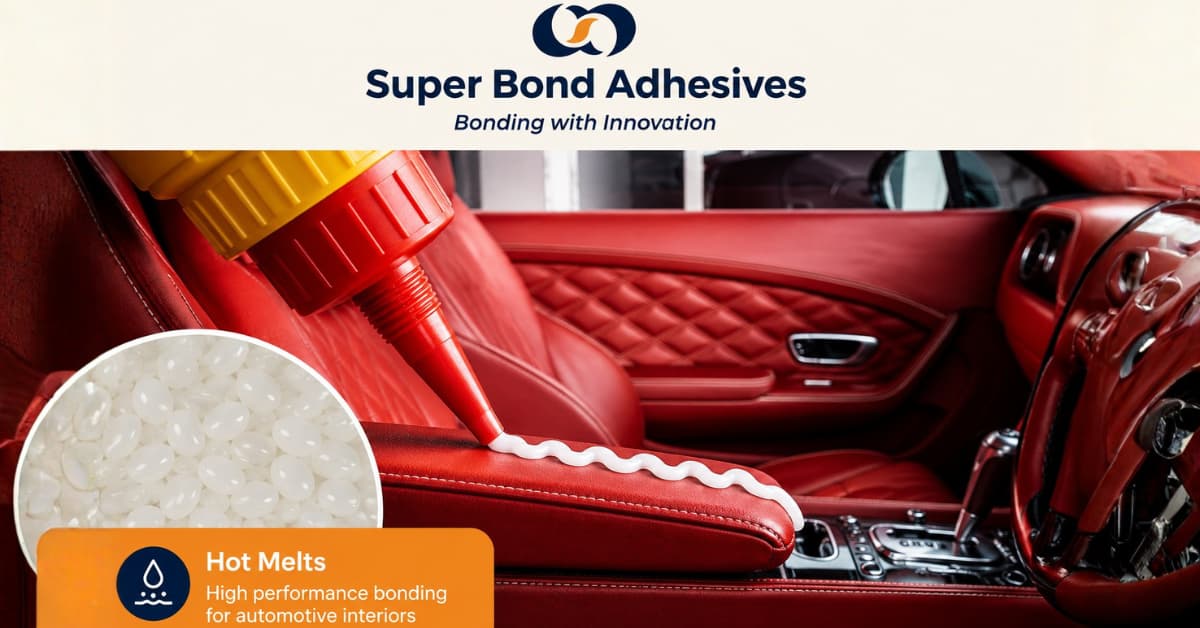
Hot-Melt Adhesive (HMA)
Hot-melt adhesive (HMA) is a 100% solid thermoplastic bonding material applied in molten form between 120°C and 200°C. It contains no solvent, requires no chemical curing, and forms a bond as it cools. Used across packaging, woodworking, hygiene product manufacturing, and electronics, HMA is one of the most widely used industrial bonding technologies in India and globally.
Every packaging plant, furniture factory, and hygiene product facility running in India today has hot-melt adhesive somewhere in the process — sealing carton flaps, bonding edge-band to panels, attaching elastics in diaper cores. Operators know it as whatever goes into the applicator on the line. They don’t need to think beyond that on a normal day. When bonds start failing, adhesive starts stringing, or consumption climbs without explanation, that’s when understanding what HMA actually is starts to matter. This guide covers the material from the ground up.
Key Characteristics of Hot-Melt Adhesives
Thermoplastic Solid Adhesive
Hot-melt adhesive comes as a solid — pellets, blocks, granules, or sticks depending on the supplier and the equipment it feeds into. Heat it past its melting point and it flows freely. Take the heat away, and it returns to solid. No component mixing, no moisture required, no solvent drying off. The product is completely solid at room temperature, so it stores without skinning over, ships without hazardous materials restrictions, and sits in a warehouse without deteriorating.
Molten Application Process
In a production environment, the adhesive is held in a heated tank above its working temperature — 120°C to 200°C for most commercial grades, sometimes higher for specialty formulations. Heated hoses carry the melt to the application head, where it exits through nozzles or guns as a bead, dot, spiral, or flat film depending on the joint design. The nozzle type and line speed together determine the deposit geometry. Getting that deposit consistent — same position, same weight, every cycle — is what keeps the line running without stringing, dripping, or adhesive building up on tooling.
Rapid Solidification and Bonding
Hot-melt bonding is a physical process, not a chemical one. Molten adhesive lands on the cooler substrate, transfers heat, stiffens, and grips. On a fast carton line, that takes less than a second. On a woodworking press where the adhesive deposit is thicker, it takes a few seconds more. No cure cycle to plan around, no oven to pass through, no fixture holding a joint in place while chemistry catches up with production speed.
Examples of Hot-Melt Adhesives
Hot-melt is a product category with a wide range of chemistries inside it. The glue stick in a school craft project and the adhesive on a diaper manufacturing line both operate on the same principle — melt, apply, cool, bond — but the raw materials, performance targets, and application requirements are entirely different.
Common Types of Hot-Melt Adhesives
EVA Hot Glue Sticks
Ethylene-vinyl acetate (EVA) is the primary base polymer used in more hot-melt products than all other chemistries combined. EVA is the basis for school glue sticks, workshop hot glue guns, and industrial applicators that seal cartons as they are packaged throughout the world. The amount of vinyl acetate (VA) in an EVA polymer affects how products behave. The greater amount of VA present in an EVA polymer will create a softer, tacky adhesive with good low-temperature flexibility; conversely, less VA will raise the softening point and create a stiffer, higher-temperature adhesive. Packaging, carton sealing, case forming, and labelling are the main applications — EVA delivers what those jobs need at a price point that makes production economics work.
Polyurethane Hot-Melt Adhesives
PUR hot-melt bonds in two distinct stages.
Stage one: the adhesive melts, gets applied, and grips as the temperature drops — same as any hot-melt.
Stage two: in the next 24 to 72 hours, the polyurethanes react with moisture from both the air and the substrate to produce additional cross-links between the adhesive masses through polyurethane chemistry. The resulting bond from this reaction will be stronger, more moisture-resistant, and superior to its initial state when placed under a continuous stress load. Kitchen cabinets, bathroom units, outdoor joinery, and structural furniture components are specified with PUR because those products face conditions that standard EVA simply can’t handle long-term.
Specialty Hot-Melt Formulations
Polyolefin and metallocene grades exist because production problems forced their development — standard EVA simply won’t bond reliably to polyethylene or polypropylene, and no amount of process adjustment changes that. Flexible packaging lines running PE film, automotive interior trim components made from PP substrates, and appliance parts where the surface energy is too low for EVA to wet properly — these are the applications where polyolefin-based hot-melt gets specified. Metallocene grades come in when viscosity consistency at lower application temperatures is required. A heat-sensitive substrate that distorts at standard EVA working temperatures, or an energy-sensitive operation where running the melter cooler has real cost implications — metallocene formulations hold tighter viscosity across a narrower temperature range, which translates to more consistent deposit weight and fewer application problems across a production shift. Each of these grades came out of a specific production failure that commodity EVA couldn’t solve.
EVA vs PUR Hot-Melt: Quick Comparison
|
|
|
|
Bond mechanism |
Thermoplastic only | Thermoplastic + moisture cure |
|
Full set time |
Under 2 seconds |
24–72 hours full cure |
|
Heat resistance |
Moderate |
High |
|
Moisture resistance |
Low–moderate |
High |
|
Reworkable |
Yes |
No — permanent after cure |
|
Best for |
Packaging, carton sealing, labelling |
Furniture, kitchen units, outdoor joinery |
| Cost | Lower |
Higher |
Composition of Hot-Melt Adhesives
A hot-melt pellet looks like nothing until you understand what’s inside it. Base polymer selection is where every formulation decision starts and where the hard limits get set.
Thermoplastic Base Polymers (e.g., EVA)
The polymer controls how the adhesive flows at working temperature, which substrates it naturally wets and bonds to, what mechanical strength the joint delivers, and the service temperature range the bond survives in the field. EVA dominates global volume because it handles the widest range of common applications at a cost that makes production economics work. When EVA runs out of capability — a substrate it won’t grip, a service temperature it can’t survive, a moisture condition that defeats it — polyolefins, polyamides, polyesters, and polyurethanes each cover a specific territory where EVA falls short. Change the base polymer and the entire formulation changes with it. Every other ingredient gets reconsidered from the beginning.
Tackifying Resins and Plasticizers
Base polymer alone doesn’t wet most production substrates fast enough at the speeds converting lines actually run. Tackifying resins close that gap. Rosin esters, hydrocarbon resins, terpene-based resins — the selection depends on the polymer the resin has to be compatible with, because an incompatible combination phase-separates in the melt and produces bond performance that varies randomly across the application area. The resin goes into the blend specifically to increase surface contact and build initial adhesion before the cooling adhesive loses its ability to flow. Plasticizers work alongside the resin to set the stiffness of the finished adhesive film — shifting the softening point down for flexible, low-temperature bonding or keeping it high where the joint needs to survive elevated service temperatures. Getting the resin-to-polymer ratio right takes real formulation work. Open time, set speed, and final bond strength are all sensitive to that balance, and the effects don’t always surface until a production trial is running.
Waxes, Oils, and Other Additives
Wax is what controls how the adhesive flows through the nozzle and how fast it stiffens once it lands on the substrate. High wax loading drops viscosity — useful for fine-nozzle dispensing systems where a thick melt would create back-pressure and inconsistent deposit weight. Lower wax loading keeps the melt thick enough for bead applications and gap filling, where the adhesive needs to stay put rather than spread. Paraffin, microcrystalline, and synthetic wax grades each produce different set speed profiles, which matters when handling strength at the bonding station is what determines whether the product moves to the next process or goes into rework. Stabilisers in the blend protect the polymer during the hours it sits in a heated melter between applications. Without them, colour shifts during a production shift are an early warning of something worse — viscosity drift that makes deposit weight inconsistent and bond performance variable across the run.
How to Use Hot-Melt Adhesive
Getting deposit weight, surface condition, and equipment temperature right before production starts is ninety percent of the job. Most line problems that get blamed on the adhesive trace back to one of those three things.
Step-by-Step: Applying Hot-Melt Adhesive Correctly
Step 1 — Clean the substrate surface
Most hot-melt bond failures that get blamed on the adhesive or the equipment are surface problems. Dust, oil film, moisture, and release agent residue all sit between the adhesive and the substrate and stop proper wetting — the adhesive lands, cools, and grips the contamination layer rather than the surface beneath it. The bond looks fine until any mechanical stress finds it. On automated lines, surface preparation is controlled upstream and operators don’t need to think about it beyond confirming the process is running correctly. For manual or semi-manual applications, the preparation step is straightforward: wipe the surface, confirm there’s no residue, and let the substrate reach ambient temperature before applying adhesive. Cold substrates — especially in facilities without climate control during Indian winters — pull heat out of the melt faster than the formulation was designed for, which shortens open time and produces weaker bonds even when everything else is correct.
Step 2 — Bring equipment to working temperature
Getting the applicator to setpoint temperature on the display is not the same as the equipment being ready to run. The heated tank reaches temperature first. The hoses, the application head, and the nozzles all take longer — and until they’re fully stabilised at working temperature, the adhesive running through them is cooler than it should be. Cold adhesive strings. It doesn’t wet the substrate properly. The deposit is inconsistent, and the bond is weak before the first carton or panel has finished the joint. Running the applicator hotter than the adhesive’s recommended working range doesn’t improve flow — it breaks the polymer down. The first sign is usually a colour shift in the melt coming out of the nozzle. Char deposits follow — carbonised adhesive building up inside the nozzle bores, narrowing the orifice, making the deposit inconsistent, and eventually blocking the nozzle completely at the worst possible moment in a production run. Verify the actual working temperature against the adhesive supplier’s data sheet and confirm every element of the dispensing circuit is stable before the line starts moving.
Step 3 — Apply consistent adhesive deposit
Deposit weight and position need to be consistent every cycle — not approximately consistent, not consistent when the line is running well. Under-application is harder to catch than over-application because the bond often looks complete from the outside. The adhesive is there, the joint closed, the carton or panel moved on — but the coverage area is smaller than the joint design requires. Contact pressure across the interface wasn’t enough to wet the full surface, and the bond has less area holding it than the load in distribution will demand. That failure shows up in the field, not on the line. Over-application is visible immediately — squeeze-out pushing onto tooling, conveyor surfaces, and the product itself. It doesn’t just waste material. Adhesive building up on equipment changes the geometry of the joint over successive cycles, causes jams when it contacts moving parts, and eventually forces a line stoppage for cleaning. Neither failure is an adhesive problem. Both are setup problems that get fixed at the dispensing system, not by changing the grade.
Step 4 — Bond before open time expires
Bring the mating surface into contact before the adhesive cools past its open time. That window is grade-dependent — EVA formulations on fast packaging lines close in under a second, PUR hot-melts stay workable longer. Apply even pressure across the joint and hold for the required dwell time.
Step 5 — Safety and cleanup
The adhesive coming out of the application head is between 150°C and 200°C. At that temperature, direct skin contact isn’t a surface burn — it’s a deep tissue injury, and the damage keeps developing after the initial contact because the heat transfers through the tissue faster than pain signals register. Operators working near hot-melt equipment need gloves rated for the actual working temperature, not standard workshop gloves, and eye protection any time the applicator is running. The vapour that comes off the melt at working temperature is not acutely toxic under normal operating conditions, but in a space without adequate airflow it accumulates to concentrations that cause headaches and respiratory irritation over a shift. Keep the area ventilated — extraction above the applicator is better than relying on general building airflow, particularly in enclosed production areas where ambient temperature is already high.
A blocked nozzle clears by running fresh adhesive through it at full working temperature — that’s it. The blockage is solidified adhesive or char, and fresh hot melt coming through at operating pressure and temperature dissolves and flushes it out. What doesn’t work is pushing anything solid into the nozzle bore. A drill bit, a wire, a pin — any of them deform the orifice geometry, which changes the deposit shape permanently. The nozzle might flow again after that, but the deposit pattern won’t match what the joint was designed around. For cold adhesive on external surfaces — tank edges, hose fittings, conveyor frames — let it cool completely and peel it off. It releases cleanly from most hard surfaces without solvent or scraping.
How to Make Hot-Melt Adhesive
Commercial hot-melt production is a formulation-first process. What gets manufactured on the plant floor is only as good as the specification it’s built to, and that specification comes from the formulation development work done before the first production batch runs. Application requirements drive every raw material decision — substrate types, service temperature, set speed, equipment viscosity range — and those requirements have to be understood in detail before polymer selection begins. Each ingredient choice interacts with the others in ways that don’t always behave predictably until a batch runs in a real mixer and gets tested against the target substrates. The formulation is where quality gets built in. Manufacturing execution — mixer temperature control, blend homogeneity, batch-to-batch consistency — is what keeps it there. Quality checkpoints at every stage between raw material intake and finished product release are what give the converter confidence that what’s in the bag or box matches what was specified.
Choosing Base Polymers and Resins
Formulation starts from the application requirements and works backward. What substrates need to bond? What temperature does the joint have to survive? How fast must it set? What viscosity does the application equipment handle? Those answers drive polymer selection. High-VA EVA suits flexible, low-temperature bonding jobs. Lower-VA grades handle applications that need a higher softening point. Where EVA runs out of capability — extreme heat, chemically resistant substrates, structural strength requirements — polyolefin, polyamide, or polyurethane polymers take over.
Resin selection follows polymer selection because compatibility between the two is a hard requirement. Incompatible combinations phase-separate in the melt, produce hazy, unstable product, and deliver bond performance that varies randomly across the application area. Wax grade and loading get decided last, targeting the specific viscosity and set speed the application needs.
Melting and Homogenizing the Mixture
Raw materials go into the production mixer — sigma blade, planetary, or extruder depending on scale. The system heats everything above the melting point of the highest-melting component and runs the mix until the product is fully uniform in colour, viscosity, and texture. Temperature discipline throughout this stage isn’t optional. Too hot and polymer degradation begins; too cool and the blend doesn’t fully combine, producing off-spec material that performs inconsistently. Stabilisers go in during mixing. Small lab batches finish in thirty minutes. Large production batches run for several hours depending on formulation complexity.
Cooling and Shaping the Adhesive
Melt that passes in-process checks gets discharged and converted to finished form. Pelletising lines run the melt onto a cooling belt or into a water bath, solidifying it before cutting into uniform granules. Pillow-pack lines deposit measured volumes into non-stick film packaging that shapes around the cooling mass. Stick lines push the melt through a cooled die at a controlled rate. Cooling speed is managed deliberately — too fast creates internal stress that affects melt behaviour; too slow extends cycle time and risks contamination. Every batch gets tested for viscosity at working temperature, softening point, open time, and bond strength on the target substrates before release.
Benefits of Hot-Melt Adhesives
Manufacturing operations across India have been switching from water-based and solvent-based adhesives to hot-melt for years. The same practical reasons keep driving that shift.
Rapid Bonding and High Efficiency
Bond formation happens as the adhesive cools — seconds on most production lines, fractions of a second on fast packaging equipment. No drying stage holding up the line. No curing oven taking up floor space and energy budget. No fixtures occupied for extended periods waiting for chemistry to complete. A packaging line running hundreds of cartons a minute requires that speed just to hit its output targets. A furniture assembly operation benefits because bonded parts move straight to the next process rather than sitting in a curing queue. Water-based adhesive systems at the same line speed can’t deliver that throughput.
Solvent-Free (Low VOC) Process
There is no solvent in a hot-melt formulation. Nothing evaporates during application, which removes an entire layer of compliance obligations. No atmospheric emissions monitoring. No explosion-proof equipment. No VOC permit conditions to manage. For manufacturers facing tighter environmental regulation or looking to reduce the complexity of their compliance obligations, hot-melt removes the source of the problem rather than adding controls around it.
Strong, Durable Bonds
Standard EVA hot-melt holds reliably through the temperature and mechanical conditions that packaging and assembly products encounter in normal distribution and use. PUR hot-melt is a different level — the moisture-cure reaction that runs over 24 to 72 hours after application produces a bond that survives boiling water tests, outdoor exposure, and sustained load that would eventually cause an EVA joint to creep and release. Grade selection for the service conditions the bond will actually face is what determines long-term performance.
Main Applications of Hot-Melt Adhesives
Open a cardboard shipping box today, sit down on upholstered furniture, or use any disposable hygiene product — somewhere in the manufacturing of those items, hot-melt adhesive did part of the work.
Packaging and Printing
Carton sealing runs on hot-melt. Every cardboard box that closes with glued flaps is sealed at the end of a packaging line with hot-melt applied in less than a second per carton. Tray forming, case erecting, display unit assembly, and flexible film lamination all use it for the same reasons — fast set, consistent application, and no delay for drying. In publishing, perfect binding — the method used for paperbacks, product catalogues, and instruction manuals — relies on a hot-melt spine bond to hold pages together through years of use.
Woodworking and Furniture
Edge-banding is the most visible hot-melt application in everyday life, even though most people don’t notice it. The narrow material strip covering the raw edge of a flat-pack panel is applied with hot-melt on an automated edge-banding machine and trimmed flush in a single continuous pass. Veneer lamination, panel pressing, frame assembly, and profile wrapping all use hot-melt grades selected for the substrate pairing and the durability the product needs. India’s furniture manufacturing sector has grown considerably in scale and organisation over the past decade, and hot-melt usage across that sector has grown alongside it as hand-applied glue gave way to automated bonding systems.
Hygiene Products, Electronics and Beyond
Diaper manufacturing runs hot-melt harder than almost any other application. Elastic attachment, core stabilisation, construction bonding, and backsheet lamination all run simultaneously at machine speeds where inconsistent adhesive performance generates rejected product in seconds. In electronics, hot-melt handles wire tacking, component encapsulation, and assembly bonding where fast set and electrical compatibility are both requirements. Automotive interior trim, medical device assembly, textile lamination, and footwear manufacturing all use hot-melt — each in a grade developed specifically for what that production environment needs from the bonding material.
Frequently Asked Questions — Hot-Melt Adhesive
Q: What is hot-melt adhesive?
Hot-melt adhesive is a 100% solid thermoplastic material that melts when heated and bonds as it cools. It contains no solvent or water, requires no curing stage, and is used in packaging, woodworking, hygiene products, and electronics manufacturing.
Q: What temperature does hot-melt adhesive apply at?
Most commercial hot-melt grades apply between 120°C and 200°C. The specific working temperature depends on the base polymer and formulation — EVA grades typically run between 150°C and 180°C, while some specialty grades run higher.
Q: What is the difference between EVA and PUR hot-melt?
EVA hot-melt sets through cooling only and suits packaging, labelling, and general assembly. PUR hot-melt undergoes a secondary moisture-cure reaction over 24 to 72 hours that produces a harder, more heat and moisture-resistant bond — specified for furniture, kitchen units, and outdoor joinery.
Q: What are hot-melt adhesives made of?
Hot-melt adhesives contain a thermoplastic base polymer such as EVA, tackifying resins, plasticizers, waxes, and stabilisers. Each component controls a specific performance factor — viscosity, tack, set speed, or thermal stability.
Q: Is hot-melt adhesive solvent-free?
Yes. Hot-melt adhesive contains no solvent. The bond forms through physical cooling, not solvent evaporation, which means no VOC emissions during application and no ventilation or explosion-proof equipment requirements.
Q: Who manufactures industrial hot-melt adhesive in India?
Superbond, based in Thane, Maharashtra, manufactures industrial hot-melt adhesives for production operations across India. Formulations are developed for Indian substrates, regional climate conditions, and local manufacturing environments — with direct technical support for grade selection and process optimisation.
Conclusion
Hot-melt adhesive works on a simple principle — melt it, put it where it needs to go, let it cool. What makes production results inconsistent is rarely the principle. It’s grade selection that doesn’t match the substrate, application temperature outside the working range, deposit weight drifting across shifts, or equipment that hasn’t been configured for the adhesive’s needs.
Superbond, headquartered in Thane, Maharashtra, manufactures industrial hot-melt adhesives for Indian production conditions — local substrates, regional ambient temperatures, and the manufacturing environments that factories across the country actually run in. When bonds are failing, consumption is higher than it should be, or the current product performs inconsistently batch to batch, the conversation worth having is with a manufacturer who understands both the chemistry and the process.